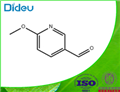
Chemical Properties
off-white to light yellow crystalline powder
Uses
Substrate used in a synthesis of flavanones via an L-proline-catalyzed condensation with
o-hydroxyarylketones.
Uses
An intermediate for the synthesis of the somatostatic sst3 receptor.
General Description
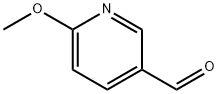
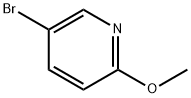
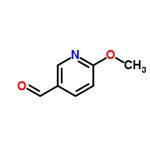
6-Methoxy-3-pyridinecarboxaldehyde, also known as 6-methoxy-3-nicotinaldehyde, can be prepared from 5-bromo-2-methoxypyridine.
Synthesis
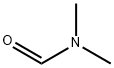
At -78 °C, N-butyllithium (50 mL, 2.5 M hexane solution) was slowly added dropwise to a solution of 5-bromo-2-methoxypyridine (22.4 g, 119.1 mmol) in anhydrous tetrahydrofuran (240 mL). After the dropwise addition, the reaction mixture was continued to be stirred at -78 °C for 90 min. Subsequently, N,N-dimethylformamide (18.5 mL, 238.3 mmol) was added slowly dropwise and stirring was continued for 90 min at -78 °C. Upon completion of the reaction, the mixture was slowly warmed to room temperature. The reaction mixture was poured into saturated sodium bicarbonate solution (1000 mL) and extracted with ether (3 x 250 mL). The organic phases were combined, dried with magnesium sulfate, filtered and concentrated to dryness to give 15.4 g (94% yield) of 6-methoxy-3-pyridinecarboxaldehyde as a light yellow solid. The product was characterized by 1H NMR (DMSO-d6): δ= 9.97 (s, 1H), 8.77 (m, 1H), 8.12 (dd, 1H, J = 8.6, 2.3 Hz), 6.99 (d, 1H, J = 8.7 Hz), 3.97 (s, 3H).LC/MS analysis (Method A): retention time = 0.25 min, purity = 92.8%, calculated mass = 137, [M + H]+ = 138. HPLC analysis (Method C): retention time = 4.9 min, purity = 95.9% (210-370 nm) and 98.7% (256 nm).
References
[1] Synthesis, 2012, vol. 44, # 5, p. 735 - 746
[2] Journal of medicinal chemistry, 2004, vol. 47, # 20, p. 4829 - 4837
[3] Patent: US2006/19965, 2006, A1. Location in patent: Page/Page column 27
[4] Synthesis, 1994, # 1, p. 87 - 92
[5] Synlett, 2009, # 15, p. 2508 - 2512