Chemical Properties
white to light beige crystalline powder
Uses
Citraconic acid is an important raw material and intermediate used in organic synthesis, pharmaceuticals, agrochemicals and dyestuff fields.
Uses
Citraconic acid is used in synthetic or copolymer oils,
in treating metals for adhesion of polyolefins, and in
thermoplastics.
Definition
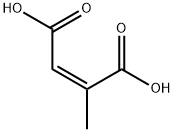
ChEBI: Citraconic acid is a dicarboxylic acid consisting of maleic acid having a methyl substituent at the 2-position. It has a role as a human metabolite. It is a dicarboxylic acid and a dicarboxylic fatty acid. It is functionally related to a maleic acid. It is a conjugate acid of a citraconate(2-).
Biological Activity
Citraconic acid is a compound with multiple biological activities that can mitigate oxidative damage and activate the Nrf2 pathway [1]. Furthermore, it exerts a protective effect against radiation-induced intestinal injury (RIII). Studies have shown that treatment with citraconic acid suppresses the radiation-induced elevation of IL-6 and TNF-α levels. It increased the number of Ki67-positive and Lgr5-positive cells, increased the number of goblet cells and mucus secretion, and restored the expression of tight junction proteins ZO-1 and occludin, thereby improving histological damage [2]. It also plays a role in alleviating endometrial fibrosis, offering a new approach for the treatment of endometriosis [3].
Synthesis
Citraconic acid can be obtained by reacting citraconic anhydride with distilled water, yielding a 94% yield. The specific reaction steps are as follows:
(1) Take a clean 100-millilitre beaker and add 22.4 g (0.2 mol) of citraconic anhydride. Then, add 4 ml (0.22 moles) of distilled water dropwise to the beaker.
(2) Place the mixture on a hotplate and stir until a homogeneous solution is formed.
(3) Cover the beaker with a bell-shaped glass lid, then leave it to stand at room temperature for 48 hours. The mixture will solidify completely. This yields 26 g of crude solid.
(4) Purification: Grind the solid obtained in (3) to a very fine powder in a mortar, wash with 50 ml of cold benzene, allow to air-dry, and then vacuum-dry for 24 hours in a vacuum desiccator containing phosphorus pentoxide. This yields 24.4 g of citraconic acid, with a melting point of 92–93 °C.

Purification Methods
Steam distil and crystallise it from EtOH/ligroin. [Beilstein 2 H 768, 2 I 309, 2 II 652, 2 III 1938, 2 IV 2230.]
References
[1] Cheng, J., Zheng, W., Yan, J., Song, S., & Ai, C. (2026). Sulfated polysaccharides from sea cucumber mitigate acetaminophen-induced acute liver injury in mice via citraconic acid-mediated inhibition of oxidative stress. Food & Function, 2, 1074–1092. https://doi.org/
10.1039/D5FO04767F[2] XiaoJie Liu. (2026). Citraconic acid mitigates radiation-induced intestinal injury by modulating IL-17 signaling to enhance epithelial regeneration. BMC Gastroenterology. https://doi.org/
10.1186/s12876-026-04689-6[3] Yuhua Zeng. (2025). Growth hormone combined with estrogen improves intrauterine adhesion fibrosis by downregulating endometrial microbial citraconic acid to target β-catenin protein. mSystems, e0169224. https://doi.org/
10.1128/msystems.01692-24