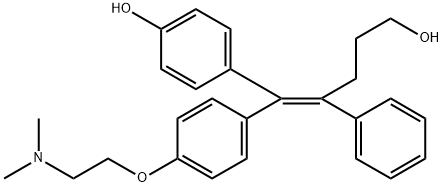
Uses
GSK5182 is a highly selective and orally active inverse agonist of estrogen-related receptor γ (ERRγ) with an IC50 of 79 nM. GSK5182 does not interact with other nuclear receptors, including ERRα or ERα. GSK5182 also induces reactive oxyen species (ROS) generation in hepatocellular carcinoma (HCC)[1][2][3].
Biological Activity
GSK5182 is an orally available 4-hydroxy-tamoxifen (4-OHT) analog and a high affinity estrogen receptor-related receptor γ (ERRγ) inverse agonist (68% inhibition at 1 μM by reporter assay) with 25-fold reduced affinity and little antagonistic activity toward ERRα (No inhibition against 100 nM estradiol-induced reporter activity up to 1 μM). GSK5182 effectively inhibits ERRγ-dependent gene expression and biological functions both in cultures (1-10 μM) and in various animal studies in vivo (10-80 mg/kg i.p. or p.o. in rats and mice).
in vivo
GSK5182 (40 mg/kg; intraperitoneal injection; every day; 25 or 30 days; db/db mice, diet-induced obesity mice) specifically inhibits the transcriptional activity of ERRγ, and suppresses hepatic glucose production through inhibition of hepatic gluconeogenesis. GSK5182 elicits anti-diabetic effects in mouse models via negative regulation of the hepatic gluconeogenesis program. GSK5182 normalizes hyperglycemia mainly through inhibition of hepatic glucose production[3].
| Animal Model: | db/db mice (male, 7-12-week-old), diet-induced obesity (DIO) mice[3] |
| Dosage: | 40 mg/kg |
| Administration: | Intraperitoneal injection; every day; 30 days for db/db mice, 25 days for DIO mice |
| Result: | Inhibited the transcriptional activity of ERRγ, suppressed hepatic glucose production through inhibition of hepatic gluconeogenesis.
|
IC 50
ERRγ: 79 nM (IC
50); Reactive Oxygen Species
References
[1] Kim JH, et al. Estrogen-related receptor γ is upregulated in liver cancer and its inhibition suppresses livercancer cell proliferation via induction of p21 and p27. Exp Mol Med. 2016 Mar 4;48:e213. DOI:
10.1038/emm.2015.115[2] Misra J, et al. ERRγ: a Junior Orphan with a Senior Role in Metabolism. Trends Endocrinol Metab. 2017 Apr;28(4):261-272. DOI:
10.1016/j.tem.2016.12.005[3] Kim DK, et al. Inverse agonist of nuclear receptor ERRγ mediates antidiabetic effect through inhibition of hepatic gluconeogenesis. Diabetes. 2013 Sep;62(9):3093-102. DOI:
10.2337/db12-0946