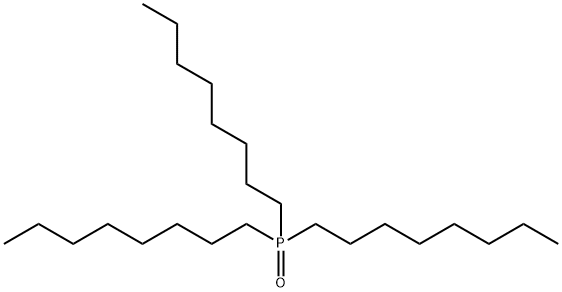
Chemical Properties
white crystalline powder
Uses
Catalyst in:
- Preparation of tetradentate planar-chiral hydroxy-substituted ferrocenecarboxaldimine Schiff base ligands
- Reactions of allyl esters with hydrosilanes
- Asymmetric cyanosilylation of aldehydes
- Preparation of chlorothiol formates from thiols and phosgene
Uses
Tri-n-octylphosphine oxide is a solvent used in the extraction of metals, especially uranium, zirconium and hafnium. It is also used as an auxiliary reagent in the solvent extraction of metals. It is also used to extract hydrogen bonding organic compounds. Further, it is useful as a capping ligand for the production of quantum dots, such as those consisting of cadmium selenide.
Uses
Trioctylphosphine oxide (TOPO) is most commonly used as the solvent due to its high boiling point and chemical stability, and its ability to prevent particle aggregation via coordination to the NP surface. trioctylphosphine oxide is a frequently used surfactant, starts to decompose at around 425℃.
Application
The industrial applications of trioctylphosphine oxide, make use of its complexing powers with metals and with hydrogen donor organic compounds. Commercial uses as a solvent extraction reagent are in the recovery of uranium from wet process phosphoric acid and in the recovery of byproduct acetic acid and furfural generated during sulphite wood pulping.
Production Methods
method 1: preparing trioctylphosphine oxide from sodium hypophosphite by performing octene addition, trichlorosilane reduction, bromoalkane addition and hydrolysis in turn;
method 2: preparing the trioctylphosphine oxide from the sodium hypophosphite by performing the octene addition, the trichlorosilane reduction, the hydrolysis and the octene addition again in turn;
method 3: preparing the trioctylphosphine oxide from the sodium hypophosphite by performing the octene addition, the trichlorosilane reduction and alcoholysis in turn.
Flammability and Explosibility
Non flammable
reaction suitability
reaction type: Buchwald-Hartwig Cross Coupling Reaction
reaction type: Heck Reaction
reaction type: Hiyama Coupling
reaction type: Negishi Coupling
reaction type: Sonogashira Coupling
reaction type: Stille Coupling
reaction type: Suzuki-Miyaura Coupling
reagent type: ligand
Purification Methods
Mason, McCarty and Peppard [J Inorg Nuclear Chem 24 967 1962] stirred a 0.1M solution in *benzene with an equal volume of 6M HCl at 40o in a sealed flask for 48hours, then washed the *benzene solution successively with water (twice), 5% aqueous Na2CO3 (three times) and water (six times). The *benzene and water were then evaporated under reduced pressure at room temperature. Zingaro and White [J Inorg Nucl Chem 12 315 1960] treated a pet ether solution with aqueous KMnO4 (to oxidise any phosphinous acids to phosphinic acids), then with sodium oxalate, H2SO4 and HCl (to remove any manganese compounds). The pet ether solution was slurried with activated alumina (to remove phosphinic acids), filtered, evaporated and the residue was recrystallised from pet ether or cyclohexane at -20o. It can also be recrystallised from EtOH. [Beilstein 4 IV 3466.]