Uses
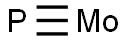
Molybdenum phosphide (MoP), as a topological semimetal, stands as a potential candidate for next-generation interconnect materials. It possesses inherent advantages including natural abundance, low cost, excellent stability, and an ideal electronic structure. Moreover, the phosphorus within it can adsorb hydrogen under low hydrogen coverage and desorb hydrogen under high hydrogen coverage, thereby exhibiting high hydrogen evolution reaction (HER) performance under both acidic and alkaline conditions.
References
[1] YANG LIU . Superhydrophilic molybdenum phosphide quantum dots on porous carbon matrix for boosting hydrogen evolution reaction[J]. Chemical Engineering Journal, 2023, 454: Article 140105. DOI:
10.1016/j.cej.2022.140105.
[2] WEI LI S. O B Dhandapani. Molybdenum Phosphide: A Novel Catalyst for Hydrodenitrogenation[J]. Chemistry Letters, 1998, 1998 1: 207-208. DOI:
10.1246/CL.1998.207.
[3] JOSHUA M. MCENANEY. Amorphous Molybdenum Phosphide Nanoparticles for Electrocatalytic Hydrogen Evolution[J]. Chemistry of Materials, 2014, 26 16: 4826-4831. DOI:
10.1021/cm502035s.
[4] YU SUN . Preparation of molybdenum phosphide nanoparticles/nitrogen-phosphorus co-doped carbon nanosheet composites for efficient hydrogen evolution reaction[J]. Journal of Solid State Chemistry, 2020, 284: Article 121182. DOI:10.1016/j.jssc.2020.121182.