Synthesis
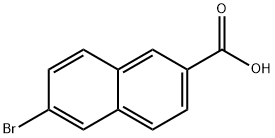
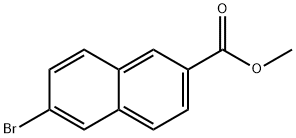
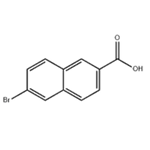
Methyl 6-bromo-2-naphthalenecarboxylate (3b) (2.7 g, 10.0 mmol) was used as a raw material to form a suspension with potassium hydroxide (1.1 g, 20.0 mmol) in methanol (50 mL) at 50 °C with vigorous stirring. At the beginning of the reaction, the suspension gradually changed to a homogeneous solution, indicating that the raw material was completely consumed. After the reaction lasted for 8 hours, about 2/3 of the volume of solvent was removed by evaporation under reduced pressure. Subsequently, water (1500 mL) was added to the residue and the unreacted esters were extracted with ethyl acetate. The aqueous phase was acidified to pH 3 with 10% H2SO4 and subsequently extracted with ethyl acetate (3 x 200 mL). The organic phases were combined, dried over anhydrous sodium sulfate and concentrated under reduced pressure to give pure 6-bromo-2-naphthalenecarboxylic acid (3a) (2.1 g, 8.4 mmol, 84% yield). The melting point of the product was 290-294 °C (decomposition). High resolution mass spectrum (ESI+): m/z [M + 1]+ calculated value (C11H8BrO2) was 252.08591, measured value was 252.08582. 1H NMR (DMSO-d6) δ= 7.72 (1H, dd, J = 8.5 and 1.8 Hz, 7-naphthalenyl H), 7.99 (1H, d, J = 8.6 Hz, 4-naphthalenyl H) ), 8.02 (1H, dd, J = 8.6 and 1.4 Hz, 8-naphthalenyl H), 8.09 (1H, d, J = 8.8 Hz, 3-naphthalenyl H), 8.30 (1H, d, J = 1.6 Hz, 5-naphthalenyl H), 8.62 (1H, s, 1-naphthalenyl H), and 13.15 (1H, br.s, COOH).13C NMR ( 125.76 MHz, DMSO-d6) δ= 121.93, 126.50, 127.61, 128.81, 129.83, 130.01, 130.64, 130.90, 131.63, 136.11, 167.30.
References
[1] Organic and Biomolecular Chemistry, 2015, vol. 13, # 27, p. 7477 - 7486
[2] Bioorganic and Medicinal Chemistry, 2012, vol. 20, # 4, p. 1557 - 1568
[3] Bioorganic Chemistry, 2011, vol. 39, # 4, p. 151 - 158
[4] Patent: US2012/88746, 2012, A1. Location in patent: Page/Page column 47-48