Description
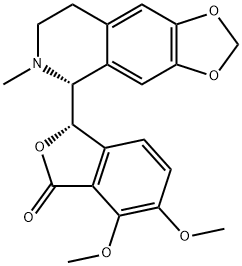
(1R,9S)-(–)-β-Hydrastine is an enantiomer of the alkaloid hydrastine that inhibits dopamine biosynthesis (IC
50 = 20.7 μM in PC12 cells) by inhibiting tyrosine hydroxylase activity. It inhibits dopamine release with an IC
50 value of 66.5 μM in the presence of high extracellular K
+ levels. It also inhibits L-type and caffeine-activated store-operated Ca
2+ channels and prevents Ca
2+ leakage from intracellular stores.
Uses
(-)-β-Hydrastine is an inhibitor of Dopamine biosynthesis.
Uses
anesthetic (local), antiarrhythmic
Definition
ChEBI: A natural product found in Hydrastis canadensis.
References
[1] SO KIM1. Effects of Hydrastine Derivatives on Dopamine Biosynthesis in PC12 Cells[J]. Planta medica, 2001, 67 1: 609-613. DOI:
10.1055/s-2001-17356[2] SHOU YU YIN . Enantio-selective inhibition of (1R,9S)- and (1S,9R)-β-hydrastines on dopamine biosynthesis in PC12 cells[J]. Neuropharmacology, 2004, 47 7: Pages 1045-1052. DOI:
10.1016/j.neuropharm.2004.07.033[3] SHOU YU YIN. Effects of (1R,9S)-beta-hydrastine on intracellular calcium concentration in PC12 cells.[J]. Biological & pharmaceutical bulletin, 2007, 30 8: 1547-1550. DOI:
10.1248/bpb.30.1547[4] SHOU YU YIN. Inhibitory effects of (1R,9S)-β-hydrastine on calcium transport in PC12 cells[J]. Archives of Pharmacal Research, 2007, 30 1: 109-113. DOI:
10.1007/bf02977786