Synthesis
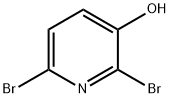
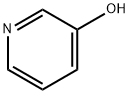
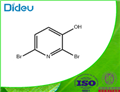
General procedure for the synthesis of 2,6-dibromo-3-hydroxypyridine from 3-hydroxypyridine: Ice-cold bromine (16.2 mL, 315 mmol) was added dropwise to a stirring 2.5 M sodium hydroxide solution (320 mL, 800 mmol). This mixed solution was then slowly added to a 2.5 M sodium hydroxide solution (110 mL, 275 mmol) containing 3-hydroxypyridine (10.0 g, 105 mmol). The reaction mixture was stirred at 0 °C for 1 hour, followed by continued stirring at room temperature for 4 hours. Upon completion of the reaction, a small amount of precipitate was removed by filtration. The filtrate was cooled and the pH was adjusted to 1 with concentrated hydrochloric acid, at which point a solid precipitated. The solid product was collected by filtration, washed with water, dried, and recrystallized from carbon tetrachloride to give 2,6-dibromo-3-hydroxypyridine (12.1 g, 46% yield) as a beige solid. The product was characterized by 1H NMR (400 MHz, DMSO-d6): δ= 11.14 (br s, 1H), 7.47 (d, J = 8.0 Hz, 1H), 7.26 (d, J = 8.0 Hz, 1H); mass spectra (ES-ve) m/z: 250, 252, 254 (M-H)-.
References
[1] Bioorganic and Medicinal Chemistry, 2014, vol. 22, # 15, p. 4298 - 4311
[2] Australian Journal of Chemistry, 1981, vol. 34, # 4, p. 927 - 932
[3] Patent: WO2010/56549, 2010, A1. Location in patent: Page/Page column 97
[4] Bioorganic and Medicinal Chemistry Letters, 2014, vol. 24, # 24, p. 5630 - 5634
[5] Patent: WO2013/181931, 2013, A1. Location in patent: Page/Page column 40