Uses
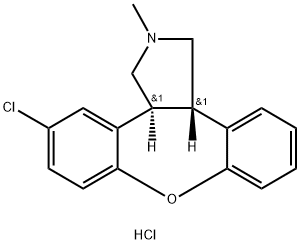
Asenapine hydrochloride, an antipsychotic, is a 5-HT (1A, 1B, 2A, 2B, 2C, 5A, 6, 7) and Dopamine (D2, D3, D4) receptor antagonist with Ki values of 0.03-4.0 nM for 5-HT and 1.3, 0.42, 1.1 nM for Dopamine receptor, respectively.
in vivo
Asenapine is an atypical antipsychotic that is currently available for the treatment of schizophrenia and bipolar I disorder. Asenapine may have superior therapeutic effect on anxiety symptoms than other agents in rats[3]. Asenapine has anxiolytic-like effects in the EPM and the defensive marble burying tests in mice[4].
IC 50
sPLA2: 2.5 nM (Ki); 5-HT
2A Receptor: 0.06 nM (Ki); 5-HT
2C Receptor: 0.03 nM (Ki); 5-HT
7 Receptor: 0.13 nM (Ki); D
2 Receptor: 1.3 nM (Ki); D
3 Receptor: 0.42 nM (Ki); D
4 Receptor: 1.1 nM (Ki)
References
[1] Stoner SC, Pace HA. Asenapine: a clinical review of a second-generation antipsychotic. Clin Ther. 2012 May;34(5):1023-40. DOI:
10.1016/j.clinthera.2012.03.002[2] Shahid M, et al. Asenapine: a novel psychopharmacologic agent with a unique human receptor signature. J Psychopharmacol. 2009 Jan;23(1):65-73. DOI:
10.1177/0269881107082944[3] Ohyama M,et al. Asenapine reduces anxiety-related behaviours in rat conditioned fear stress model. Acta Neuropsychiatr. 2016 Dec;28(6):327-336. DOI:
10.1017/neu.2016.17[4] Ene HM, et al. Effects of repeated asenapine in a battery of tests for anxiety-like behaviours in mice. Acta Neuropsychiatr. 2016 Apr;28(2):85-91. DOI:
10.1017/neu.2015.53