General Description
6-Chloro-1H-pyrazolo[4,3-c]pyridine is the key starting material for the synthesis of 1-(1H-pyrazolo[4,3-c]pyridin-6-yl)urea ERK inhibitors. By iodinating the C-3 position and protecting the N-1 position with a triphenylmethyl group, it can be used to prepare 6-chloro-3-iodo-1-trityl-1H-pyrazolo[4,3-c]pyridine[5].
Synthesis
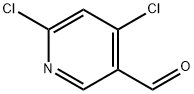
4,6-Dichloropyridine-3-carbaldehyde (3.7 g, 32 mmol), hydrazine (3.5 mL, 110 mmol) and N,N-diisopropylethylamine (20 mL) were combined in DMA (100 mL) and stirred at 80° C. for four hours. Then, the solution was cooled to room temperature, diluted with EtOAc, and washed three times with water and then with brine. The organic solution was concentrated and the resulting mixture was precipitated from dichloromethane to give 6-chloro-1H-pyrazolo[4,3-c]pyridine. Yield 2 g (41%). LCMS (ESI): calc. C6H4ClN3=153; obs. M+H=154.
![6-Chloro-1H-pyrazolo[4,3-c]pyridine synthesis](/NewsImg/2023-05-30/6382106337979555827857004.png "6-Chloro-1H-pyrazolo[4,3-c]pyridine synthesis")
References
[1] Patent: WO2015/38417, 2015, A1. Location in patent: Page/Page column 78
[2] Patent: WO2013/169704, 2013, A2. Location in patent: Paragraph 0232
[3] Patent: WO2014/210354, 2014, A1. Location in patent: Page/Page column 41
[4] Bioorganic and Medicinal Chemistry Letters, 2008, vol. 18, # 20, p. 5648 - 5652
[5] Lim*, J., Kelley, E. H., Methot, J. L. (2016). Discovery of 1-(1H-Pyrazolo[4,3-c]pyridin-6-yl)urea Inhibitors of Extracellular Signal-Regulated Kinase (ERK) for the Treatment of Cancers.
Journal of Medicinal Chemistry,
59 13, 6501–6511.
https://doi.org/10.1021/acs.jmedchem.6b00708

![6-Chloro-1H-pyrazolo[4,3-c]pyridine Structure](https://www.chemicalbook.com/CAS/GIF/1206979-33-0.gif)