Uses
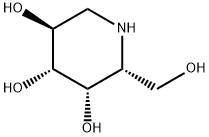
Migalastat (GR181413A free base) is an orally active α-galactosidase A molecular chaperone, with an IC50 value of 0.04 μM for human α-Gal A. Migalastat binds to the active site of certain unstable mutant forms of α-galactosidase A, facilitating their transport to the lysosome. After dissociation in the acidic environment, Migalastat enables the mutant α-galactosidase A to exhibit biological activity[1].
in vivo
Fabry disease is an X-linked recessive disorder caused by the deficient activity of α-galactosidase A[2].
Migalastat (oral gavage, 3 mg/kg daily for 4 weeks) increases α-Gal A activity in heart, kidney, spleen, and liver in a dose- and time-dependently in transgenic mice that express human mutant alpha-Gal A (TgM)[2].
Migalastat shows the half-life of less than 1 day in all major issues in TgM for 2 weeks pretreatment[2].
Migalastat (oral gavage, 100 mg/kg daily for 28 days) to transgenic mice reduces lyso-Gb3 levels up to 64%, 59%, and 81% in kidney, heart, and skin, respectively[3].
| Animal Model: | Male nontransgenic (Non-Tg) C57BL/6 mice; transgenic mice expressing human mutant R301Q α-Gal A (TgM), α-Gal A knockout mice (KO), mice express human R301Q α-Gal A in a null background (TgM/KO)[2] |
| Dosage: | 3 mg/kg |
| Administration: | Oral gavage; every day for 4 weeks |
| Result: | Reduced Globotriaosylceramide (Gb3) storage remarkably in kidney of mice. |
References
[1] Asano N, et al. In vitro inhibition and intracellular enhancement of lysosomal alpha-galactosidase A activity in Fabry lymphoblasts by 1-deoxygalactonojirimycin and its derivatives. Eur J Biochem. 2000 Jul;267(13):4179-86. DOI:
10.1046/j.1432-1327.2000.01457.x[2] Ishii S, et al. Preclinical efficacy and safety of 1-deoxygalactonojirimycin in mice for Fabry disease. J Pharmacol Exp Ther. 2009 Mar;328(3):723-31. DOI:
10.1124/jpet.108.149054[3] Young-Gqamana B, et al. Migalastat HCl reduces globotriaosylsphingosine (lyso-Gb3) in Fabry transgenic mice and in the plasma of Fabry patients. PLoS One. 2013;8(3):e57631. DOI:
10.1371/journal.pone.0057631[4] Welford RWD, et al. Glucosylceramide synthase inhibition with lucerastat lowers globotriaosylceramide and lysosome staining in cultured fibroblasts from Fabry patients with different mutation types. Hum Mol Genet. 2018 Oct. 27(19):3392-3403. DOI:
10.1093/hmg/ddy248