Uses
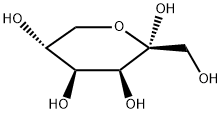
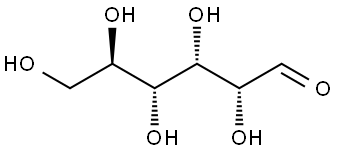
In the manufacture of vitamin C (accounts for nearly 1000 tons of ascorbic acid produced every year). For conversion of L-sorbose to 2-keto-L-gulonic acid see Reichstein, Grüssner, Helv. Chim. Acta 17, 311 (1934).
Synthesis
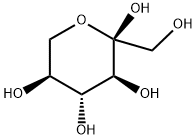
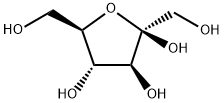
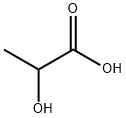
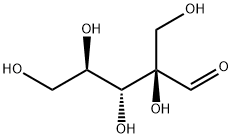
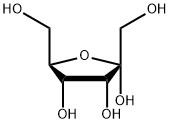
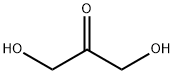
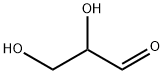
The target compounds were synthesized from D-fructose by the following steps: 2-hydroxypropanoic acid, D-witch hazel sugar, (3S,4R,5S)-1,3,4,5,6-pentahydroxyhexan-2-one, (3S,4S,5R)-1,3,4,5,6-pentahydroxyhexan-2-one, (3R,4R,5R)-1,3,4,5,6-pentahydroxyhexan-2-one, 1 ,3-dihydroxyacetone and DL-glyceraldehyde. This was done as follows: the D-fructose was reacted with MoO3 in water at 100 °C for 4 h. After completion of the reaction, the fructose-containing grades were separated by appropriate methods. Analysis using 1H NMR spectroscopy (shown in Fig. 8) confirmed the presence of sorbose in the separated grades.