Description
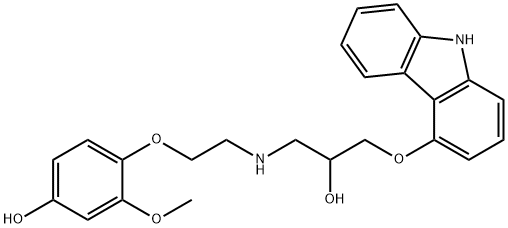
4’-hydroxyphenyl Carvedilol is a metabolite of carvedilol that is a more potent β-adrenergic receptor antagonist than carvedilol but has weaker vasodilatory activity. It is formed through oxidation primarily by the cytochrome P450 (CYP) isoform CYP2D6. 4’-hydroxyphenyl Carvedilol inhibits the formation of DPPH radicals in a cell-free assay.
Chemical Properties
Off-White Solid
Uses
A metabolite of Carvedilol (C184625). It is used in the treatment of hypertension.
Uses
4'-Hydroxyphenyl Carvedilol is an optically active metabolite of Carvedilol which is a multiple-action, neurohormonal antagonist that is used in the treatment of hypertension.
Uses
An optically active metabolite of Carvedilol (C184625), a nonselective -adrenergic blocker with α1-blocking activity.
Definition
ChEBI: 4'-Hydroxyphenyl Carvedilol is a member of carbazoles.
References
[1] DAXESH P. PATEL. UPLC-MS/MS assay for the simultaneous quantification of carvedilol and its active metabolite 4′-hydroxyphenyl carvedilol in human plasma to support a bioequivalence study in healthy volunteers[J]. Biomedical Chromatography, 2013, 27 8: 974-986. DOI:
10.1002/bmc.2889[2] H G OLDHAM S E C. In vitro identification of the human cytochrome P450 enzymes involved in the metabolism of R(+)- and S(-)-carvedilol.[J]. Drug Metabolism and Disposition, 1997, 25 8: 970-977.
[3] THOMAS C MALIG. Comparison of free-radical inhibiting antioxidant properties of carvedilol and its phenolic metabolites.[J]. MedChemComm, 2017: 606-615. DOI:
10.1039/c7md00014f