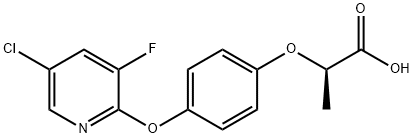
Description
Clodinafop is a herbicide for annual grass weed control usually used as the propargyl variant. It is not expected to be persistent in soil systems but, under certain conditions it can be persistent in aquatic systems. Based on its physico-chemical properties it may leach to groundwater. Based on the data available it is moderately toxic to most biodiversity. It may be a mammalian reproduction/developmental toxin.
Uses
(R)-Clodinafop is used as herbicides for weed control in wheat.
Definition
ChEBI: An aromatic ether that is (R)-lactic acid in which the hydroxy group at position 2 has been converted to the corresponding p-[(5-chloro-3-fluoropyridin-2-yl)oxy]phenyl ether. It is the parent acid of the herbicide clodinafop-p
opargyl.
Production Methods
Clodinafop is commercially produced through a multi-step synthesis that constructs its chiral aryloxyphenoxypropionic acid structure. The process typically begins with the preparation of a chloro-fluoro-substituted pyridine derivative, which is then coupled with a phenol intermediate via etherification to form the aryloxy linkage. This is followed by esterification or amidation with (R)-lactic acid or its derivatives to introduce the propanoic acid moiety with the desired stereochemistry and produce final product, clodinafop.
Mechanism of action
Systemic, contact acting. Acetyl CoA carboxylase inhibitor (ACCase) - distrupts fatty acid biosynthesis and lipid formation.
Pesticide Type
Herbicide; Metabolite; Plant Growth Regulator