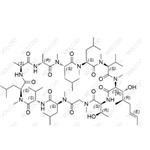
Description
Cyclosporin C is a fungal metabolite that has been found in
T. inflatum and has diverse biological activities, including antifungal, antiviral, and immunosuppressant properties. It is active against isolates of
B. cinerea,
A. niger, and
Alternaria,
Mucor, and
Penicillium species (MICs = 0.1-5 μg/ml). Cyclosporin C (15 μg/ml) inhibits vaccinia virus replication in infected BSC40 cells by 98.82%. It inhibits lymphocyte proliferation induced by the mitogens concanavalin A (ConA; ), phytohemagglutinin L (PHA), and pokeweed mitogen (PWM), as well as proliferation induced by alloantigen in mixed lymphocyte culture when used at a concentration of 100 ng/ml. Cyclosporin C (100 ng/ml) inhibits the local graft
versus host (GVH) reaction in mice receiving splenocyte grafts.
Chemical Properties
White Solid
Uses
A group of nonpolar cyclic oligopeptides with immunosupppressant activity.
Uses
Cyclosporin C is a minor analogue of the cyclosporin complex produced by a number of fungal species, including Trichoderma, Tolypocladium, Fusarium, Nectria and Acremonium. Cyclosporin C possesses immunosuppressant activity but has been much less extensively investigated than the major analogue, cyclosporin A.
References
[1] A VON WARTBURG R T. Cyclosporins, fungal metabolites with immunosuppressive activities.[J]. Progress in medicinal chemistry, 1988, 25: 1-33. DOI:
10.1016/s0079-6468(08)70276-5[2] M MOUSSAF. Cyclosporin C is the main antifungal compound produced by Acremonium luzulae.[J]. Applied and Environmental Microbiology, 1997, 63 5: 1739-1743. DOI:
10.1128/aem.63.5.1739-1743.1997[3] C R DAMASO N M. Inhibition of vaccinia virus replication by cyclosporin A analogues correlates with their affinity for cellular cyclophilins.[J]. Journal of General Virology, 1998, 79 ( Pt 2): 339-346. DOI:
10.1099/0022-1317-79-2-339[4] N SADEG. In vitro and in vivo comparative studies on immunosuppressive properties of cyclosporines A, C, D and metabolites M1, M17 and M21.[J]. Immunopharmacology and Immunotoxicology, 1993, 15 2-3: 163-177. DOI:
10.3109/08923979309025992