Uses
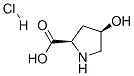
Cis-4-Hydroxy-D-proline belongs to the class of organic compounds known as proline and derivatives. Proline and derivatives are compounds containing proline or a derivative thereof resulting from a reaction of proline at the amino group or the carboxyl group, or from the replacement of any hydrogen of glycine by a heteroatom. cis-4-Hydroxy-D-proline is a substrate that may be used to study the specificity and kinetics of D-alanine dehydrogenase.
Synthetic Application
Cis-4-Hydroxy-D-proline may be used as a starting material for the 13-step synthesis of new conformationally restricted PNA adenine monomer and the synthesis of N-Benzyl pyrrolidinyl sordaricin derivatives. Cis-4-Hydroxy-D-proline is a substrate that may be used to study the specificity and kinetics of D-alanine dehydrogenase. Cis-4-Hydroxy-D-proline may be used to analyze the substrate specificity of amino acid transporter PAT1.
Uses
cis-4-Hydroxy-D-proline hydrochloride is a non-cleavable ADC linker used in the synthesis of antibody-drug conjugates (ADCs). cis-4-Hydroxy-D-proline hydrochloride is also a alkyl chain-based PROTAC linker that can be used in the synthesis of PROTACs.
Synthesis
A mixture of (2S,4R)-4-hydroxypyrrolidine-2-carboxylicacid(50 mmol, 6550 mg) and Ac2O (250 mmol, 23.5 mL) in AcOH (100 mL) wasstirred at reflux for 6 h. The resulting mixture was concentrated to give thecrude intermediate. The solution of this crude intermediate in 2 N HCl (50 mL)was stirred at reflux for 3 h. Then activated charcoal (1 g) was added, the hotmixture was ltered immediately through a Celite layer. The filtrate was concentrated in vacuo to give the crude intermediate.The crude intermediate was dissolved in acetone and filtered. The residue was washed twice with ether anddried in vacuo to give cis-4-Hydroxy-D-proline hydrochloride as a white solid (7.54 g, 90percent).
IC 50
Non-cleavable Linker
References
[1] Beck A, et al. Strategies and challenges for the next generation of antibody-drug conjugates. Nat Rev Drug Discov. 2017;16(5):315-337. DOI:
10.1038/nrd.2016.268[2] Nalawansha DA, et al. PROTACs: An Emerging Therapeutic Modality in Precision Medicine. Cell Chem Biol. 2020;27(8):998-985. DOI:
10.7554/eLife.57277