Uses
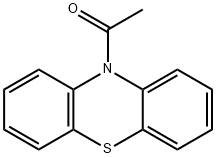
10-Acetylphenothiazine has been studied as a possible redox shuttle additive for chemical overcharge and overdischarge protection for lithium-ion batteries. It was used as a reagent in the synthesis of triazolopyridinylphenothiazines which displayed significant antibacterial and antifungal activity.
Synthesis
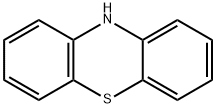
1. 20 g (0.1 mol) of phenothiazine and 200 mL of toluene are added to a 500 mL flask.
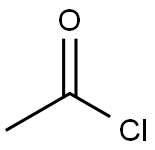
2. 14.3 mL (2 equiv.) of acetyl chloride was added slowly and dropwise to the flask.
3. The reaction mixture was stirred at 50 °C for 1 h to ensure complete reaction.
4. Upon completion of the reaction, the mixture was concentrated to dryness.
5. The resulting precipitate was dissolved in a minimal amount of isopentane followed by filtration.
6. After drying, 24 g of a beige solid product, 1-(10H-phenothiazin-10-yl)ethanone, was obtained in quantitative yield. 7. The product had a melting point of 2.0%.
7. The melting point of the product was 210-211 °C. The product was dried.
References
[1] Patent: US2005/222045, 2005, A1. Location in patent: Page/Page column 13
[2] Bioorganic and Medicinal Chemistry, 2018, vol. 26, # 14, p. 4113 - 4126
[3] European Journal of Medicinal Chemistry, 2011, vol. 46, # 1, p. 101 - 105
[4] Indian Journal of Heterocyclic Chemistry, 2018, vol. 28, # 2, p. 221 - 226
[5] Indian Journal of Chemistry - Section B Organic and Medicinal Chemistry, 2004, vol. 43, # 1, p. 157 - 161