Description
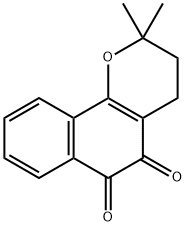
β-Lapachone (4707-32-8) is a naturally occurring quinone found in the bark of the Lapacho tree (Tabebuia avellanedae). A novel DNA topoisomerase I inhibitor which unlike camptothecin does not stabilize the cleavable complex indicating a novel mode of action.1Induces apoptosis in a number of cancer cell lines.2In cancer cells over-expressing NAD(P)H:quinone oxidoreductase, reduction of β-lapachone leads to futile cycling between quinone and hydroquinone forms3resulting in the production of reactive oxygen species4. Suppresses radiation-induced activation of NFκB.5
Chemical Properties
Orange Solid
Uses
β-Lapachone is a naturally occurring quinone obtained from the bark of the lapacho tree (Tabebuia avellanedae) with cancer chemopreventive properties. Induces apoptosis in HL-60 and human prostate cancer cells.
Uses
β-Lapachone has been used:
- as an anticancer compound in catalase-inhibitable luminol/hydrogen peroxide (HRP)-dependent chemiluminometricassay in Lewis lung carcinoma (LLC) cells and isolated mitochondria
- as a naphthoquinone to study its effects on the growth and differentiation of mice granulocyte and macrophage progenitor cells
- as a substrate to study the enzyme activity of human recombinant NAD(P)H dehydrogenase 1 (NQO1) protein
Definition
ChEBI: A benzochromenone that is 3,4-dihydro-2H-benzo[h]chromene-5,6-dione substituted by geminal methyl groups at position 2. Isolated from Tabebuia avellanedae, it exhibits antineoplastic and anti-inflammatory activi
ies.
Biochem/physiol Actions
β-Lapachone acts as a DNA topoisomerase type I inhibitor. It exhibits anti-fungal, anti-bacterial, trypanocidal, and antiviral properties. β-Lapachone also inhibits nitric oxide(NO) and inducible NO synthase (iNOS) in alveolar macrophages.
References
[1] C J LI A B P L Averboukh. beta-Lapachone, a novel DNA topoisomerase I inhibitor with a mode of action different from camptothecin.[J]. The Journal of Biological Chemistry, 1993, 268 30: 22463-22468.
[2] S M WUERZBERGER. Induction of apoptosis in MCF-7:WS8 breast cancer cells by beta-lapachone.[J]. Cancer research, 1998, 58 9: 1876-1885.
[3] J J PINK. NAD(P)H:Quinone oxidoreductase activity is the principal determinant of beta-lapachone cytotoxicity.[J]. The Journal of Biological Chemistry, 2000, 275 8: 5416-5424. DOI:
10.1074/jbc.275.8.5416[4] DAVID SIEGEL David R Chao Yan. NAD(P)H:quinone oxidoreductase 1 (NQO1) in the sensitivity and resistance to antitumor quinones[J]. Biochemical pharmacology, 2012, 83 8: Pages 1033-1040. DOI:
10.1016/j.bcp.2011.12.017[5] Beta-lapachone suppresses radiation-induced activation of nuclear factor-kappaB