Uses
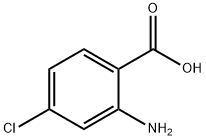
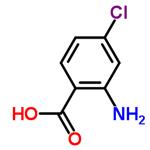
2-Amino-4-chlorobenzoic Acid is used in the preparation of quinazolinone derivatives observed to be useful in the treatment of Alzheimer’s disease. Also it aids in the synthesis of non-nucleoside, thumb pocket 2 HCV NS5B polymerase inhibitors used in Hepatitis C therapy.
Uses
2-Amino-4-chlorobenzoic acid serves as the ligand L in the solvothermal synthesis of the terbium complex [Tb(L)2(H2O)3·H2O], which exhibits bright yellow-green luminescence[1]. 2-Amino-4-chlorobenzoic acid (2-A-4-CBA), acting as the first ligand, combines with 1,10-phenanthroline, the second ligand, to form the neodymium ternary complex Eu(2-A-4-CBA)₃phen. The compound is dissolved in ethanol to serve as a reference standard in thin layer chromatography (TLC) for detecting unreacted ligands in synthesized complexes[2].
References
[1]
CHEN, Y., XING, Z., CAO, S., WANG, Y. (2016). Synthesis and luminescent properties of terbium complex with 2-amino-4-chlorobenzoic acid. Journal of Rare Earths, 34(3), 240–244.
https://doi.org/10.1016/s1002-0721(16)60020-0 [2]
Chen, Y., Wu, S., Xing, Z., Cao, S., Geng, X., Yang, Y., Xiao, L. (2015). Synthesis, structural characterization and luminescent properties of a novel europium ternary complex Eu(2-A-4-CBA)3phen. Journal of Alloys and Compounds, 649, 699–703.
https://doi.org/10.1016/j.jallcom.2015.03.137