Synthesis
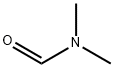
The general procedure for the synthesis of 2-chloro-4-(4-morpholino)-thieno[3,2-d]pyrimidine-6-carboxaldehyde from N,N-dimethylformamide is as follows: referring to Example 3, a solution of 2-chloro-4-morpholino-4-yl-thieno[3,2-d]pyrimidine (65) (1.75 g, 6.85 mmol) in anhydrous THF (40 mL) was stirred at -78 °C. A hexane solution of 2.5 M n-butyllithium (3.3 mL, 1.2 equiv) was slowly added. The reaction mixture was continued to be stirred at -78 °C for 1 h. Anhydrous N,N-dimethylformamide (796 μL, 1.5 eq.) was added. After keeping the reaction at -78 °C for 1 h, the reaction was slowly warmed up to room temperature. Stirring was continued at room temperature for 2 h. Upon completion of the reaction, the mixture was poured into ice/water and a yellow precipitate precipitated. The precipitate was collected by filtration and air dried to afford the target product 2-chloro-4-(4-morpholino)-thieno[3,2-d]pyrimidine-6-carboxaldehyde (1.50 g, 77% yield). The product was characterized by 1H NMR (400 MHz, DMSO-d6): δ 3.76 (4H, t, J = 4.9 Hz), 3.95 (4H, t, J = 4.9 Hz), 8.28 (1H, s), 10.20 (1H, s).
References
[1] Patent: WO2006/46031, 2006, A1. Location in patent: Page/Page column 30
[2] Patent: US2008/76768, 2008, A1. Location in patent: Page/Page column 7
[3] Patent: US2008/76758, 2008, A1. Location in patent: Page/Page column 73
[4] Patent: WO2007/122410, 2007, A1. Location in patent: Page/Page column 63
[5] Patent: WO2007/127183, 2007, A1. Location in patent: Page/Page column 136

![2-Chloro-4-morpholinothieno[3,2-d]pyrimidine-6-carbaldehyde Structure](https://www.chemicalbook.com/CAS/GIF/885618-31-5.gif)
![2-CHLORO-4-MORPHOLINOTHIENO[3,2-D]PYRIMIDINE-6-CARBALDEHYDE](/CAS/GIF/885618-31-5.gif)