Uses
Irinotecan is a topoisomerase I inhibitor for LoVo cells and HT-29 cells with IC50 of 15.8 μM and 5.17 μM, respectively
Uses
(+)-Irinotecan is a Topo I inhibitor.
Definition
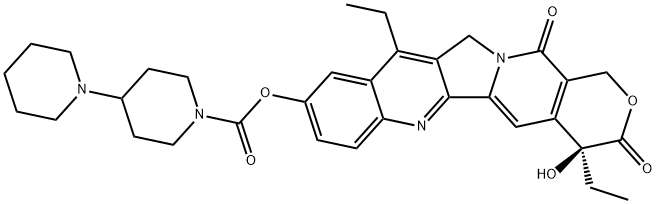
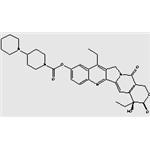
ChEBI: A member of the class of pyranoindolizinoquinolines that is the carbamate ester obtained by formal condensation of the carboxy group of [1,4'-bipiperidine]-1'-carboxylic acid with the phenolic hydroxy group of (4S)-4,11-diethyl-4,9-dihydro
y-1H-pyrano[3',4':6,7]indolizino[1,2- hydrochloride]quinoline-3,14-dione. Used (in the form of its hydrochloride salt trihydrate) in combination with fluorouracil and leucovorin, for the treatment of patients with metastatic adenocarcino
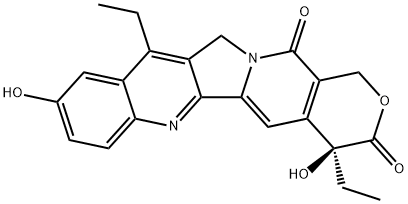
a of the pancreas after disease progression following gemcitabine-based therapy. It is converted via hydrolysis of the carbamate linkage to its active metabolite, SN-38, which is ~1000 times more active.
brand name
Camptosar (Pharmacia &Upjohn)
.
Biological Activity
irinotecan (cpt-11), a prodrug for treating metastatic colorectal cancer, is a topoisomerase i inhibitor for lovo cells and ht-29 cells with ic50 of 15.8 μm and 5.17 μm, respectively [1].in vivo, irinotecan is converted to sn-38, its most active metabolite, by carboxylesterase converting enzyme (cce) [2].
Synthesis
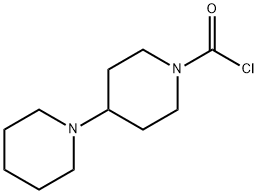
(S)-4,11-diethyl-4,9-dihydroxy-1H-pyrano[3',4':6,7]indolizino[1,2-b]quinoline-3,14(4H,12H)-dione was synthesized using piperidinyl piperidine carbonyl chloride and (S)-4,11-diethyl-4-hydroxy-3,14-dioxo-3,4,12,14-tetrahydro-1H-pyrano[ 3',4':6,7]indolo[1,2-b]quinolin-9-yl [1,4'-bipiperidin]-1'-carboxylate was prepared in the following general steps: under nitrogen protection, (S)-4,11-diethyl-4,9-dihydroxy-1H-pyrano[3',4':6,7]indolo[1,2-b]quinolin-3,14(4H,12H)-dione (20 g ) was suspended in dichloromethane and acetamide (3 g) and pyridine (60 ml) were added. Subsequently, piperidinyl piperidine carbonyl chloride (17.6 g) was dissolved in dichloromethane and triethylamine (20 ml) was added and this solution was slowly added to the above suspension. The reaction mixture was stirred at 30-40°C for 2 hours. After completion of the reaction, the solvent was removed by distillation under reduced pressure at 50°C and hexane was added as a counter-solvent to promote crystallization. The crystalline product was collected by filtration, washed with hexane and dried under reduced pressure at 50 °C to give 28.4 g of the target product in 95% yield.HPLC analysis showed 99.9% purity of the product.
in vitro
irinotecan induced similar amounts of cleavable complexes in lovocells and ht-29 cell lines with the ic50 of 15.8 μm and 5.17 μm, respectively [1].after addition of 157 mm irinotecan to plasma, sn-38 concentration showed linear increase during the first 60-min period, followed by a plateau.in the first 60 min, mean and standard deviation of the conversion rate were 515.9 ± 50.1 pmol/ml/h (n = 69), with a coefficient of variation of 0.097 [2]. irinotecan (cpt-11) was significantly more active in sclc than in nsclccelllines (p = 0.0036). ce activity appeared to be associated with higher sensitivity to cpt-11 in human lung cancercelllines and may partly explain the difference in the in vitro sensitivity to cpt-11 between sclc and nsclccells [3].in vitro, the sensitivity to cpt-11 and sn-38 was highest in ls174t and colo 320cells, intermediate in sw1398cellsand lowest in colo 205 and widr cells. the activity of sn-38 was 130 to 570 times than cpt-11[4].
in vivo
in colo 320 xenografts, irinotecan induced a maximum growth inhibition of 92% [4].a single dose of irinotecan significantly increased amounts of topoisomerase i covalently bound to dna in stomach, duodenum, colon and liver. concomitantly, the irinotecan-treated group exihibited significantly higher amounts of dna strand breaks in colon mucosa cells compared to the control group [5].
References
[1]. tobin p, clarke s, seale j p, et al. the in vitro metabolism of irinotecan (cpt‐11) by carboxylesterase and β‐glucuronidase in human colorectal tumours[j]. british journal of clinical pharmacology, 2006, 62(1): 122-129.
[2]. shingyoji m, takiguchi y, watanabe‐uruma r, et al. in vitro conversion of irinotecan to sn‐38 in human plasma[j]. cancer science, 2004, 95(6): 537-540.
[3]. van ark-otte j, kedde m a, van der vijgh w j, et al. determinants of cpt-11 and sn-38 activities in human lung cancer cells[j]. british journal of cancer, 1998, 77(12): 2171.
[4]. jansen w j m, zwart b, hulscher s t m, et al. cpt-11 in human colon-cancer cell lines and xenografts: characterization of cellular sensitivity determinants[j]. international journal of cancer, 1997, 70(3): 335-340.
[5]. na y s, jung k a, kim s m, et al. the histone deacetylase inhibitor pxd101 increases the efficacy of irinotecan in in vitro and in vivo colon cancer models[j]. cancer chemotherapy and pharmacology, 2011, 68(2): 389-398.