Uses
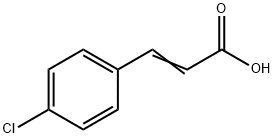
4-Chlorocinnamic Acid is a derivative of Cinnamic Acid (C442030) and plays an important role in the development of plants. 4-Chlorocinnamic Acid may also show potential antimicrobial, antioxidant, anti-inflammatory, and antitumoral activity.
Synthesis
To a 100mL three-necked round-bottomed flask, 1.41g (0.01mol) of p-chlorobenzaldehyde, 1.27g (0.011mol) of malonic acid, and 0.77g (0.01mol) of ammonium acetate were added and mixed well. A thermometer and a spherical condenser tube were connected and the reaction was carried out in a microwave reactor. After the reaction was completed, 5 mL of water was heated into the flask and the unreacted p-chlorobenzaldehyde was removed by distillation with water vapor. Add 10% sodium hydroxide solution 5mL to 6mL, add activated carbon to remove the color, extract filtration, transfer the filtrate to a beaker, acidify with concentrated hydrochloric acid until the Congo red paper turns blue or pH = 3 to 4. Cool to precipitate the crystals, extract filtration, wash the precipitate with a small amount of water, extract dry, and dry the crude product. Recrystallize with water-ethanol (1:3 v/v) and dry. The yield was calculated, and the optimal synthesis conditions were: material ratio of n(p-chlorobenzaldehyde):n(malonic acid):n(ammonium acetate) = 1.0:1.1:1.0, reaction time of 13 min, power of 800 W, and a yield of 85.8% under these conditions. Melting point determination and infrared spectral analysis were carried out. Compared with the traditional method, it has the advantages of short time, high yield and less pollution.
Purification Methods
Recrystallise the acid from EtOH or aqueous EtOH (charcoal). UV has max at 275nm (EtOH). [Walling & Wolfstirn J Am Chem Soc 69 852 1947, Beilstein 9 H 596, 9 II 395, 9 III 2727, 9 IV 2033.]