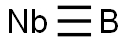
Chemical Properties
gray powder(s); ortho-rhomb, a=0.3298 nm, b=0.872 nm, c=0.3166nm; resistivity 64.5μοhm· cm at 25°C; refractory material; commonly prepared by hot-pressing boron with niobium or niobium hydride; used as sputtering target with 99.5% purity to produce wear-resistant and semiconductor films, and can provide neutron absorbing layers on nuclear fuel pellets [KIR78] [KIR81] [CER91] [ALF93]
Synthesis
1, raw material preparation
The first step: niobium oxide powder with a particle size of 0.1μm, 3μm boron carbide powder and 3μm B2O3 powder were mixed uniformly in the ratio of 70:14:3 to obtain raw material powder 1.
Step 2: Mix the above raw material powder 1 with phenolic resin in the ratio of 5:0.5 by weight in a mixing mill, cure at a temperature of 80C, and then pulverize in a pulverizer to make raw material powder 2 with an average particle size of 10μm.
Step 3: Mix the above raw material powder 2 with phenolic resin in the proportion of 5:1 by weight in the mixing mill, curing at a temperature of 50, and then pulverized in the pulverizer to make the raw material powder 3 with an average particle size of 20μm.
Step 4: Mix the above raw material powder 3 with phenolic resin in the proportion of 5:2 by weight in the mixing mill, curing at a temperature of 40 , and then pulverized in the pulverizer to make an average particle size of 50μm raw material powder 4.
2. Synthesis of niobium boride powder
The above raw material powder 4 was briquetted under the pressure of 0.5Mpa, and then fired under argon atmosphere at the temperature of 1350C for 6 hours to produce niobium boride block.
3. Decarburization
The above niobium boride block is decarburized by holding it in oxidizing atmosphere at a temperature of 350C for 12 hours, and then crushed after cooling to produce niobium boride powder.
The purity of the raw materials used were 99.99% pure.