Application
Footwear
- Abrasion resistance
- Cutting and chunking resistance
- Flex life improvement
Rolls
- Abrasion resistance
- Aging resistance
- Processing- Set reduction (better load bearing)
- Reduced water swell
- Lower hysteresis
Mechanical Molded Goods
- Increased modulus
- Better heat aging
- Compression set reduction
- Dynamic property improvement
- Reduced swell to polar liquids
- Filler substitution (non-black for black)
Hose
- Improved abrasion on cover
- Better heat aging
- Increased modulus
- Lower compression set
- Improved adhesion to reinforcing elements
Solid Tires
- Improved abrasion
- Lower hysteresis
- Higher modulus
- Improved processing
- Possibly better adhesion
Tires
- Treads for abrasion, hot tear
- Carcass for adhesion and/or filler substitution
- Breaker (belt) stocks for adhesion
Belts
Flat Belts
- Increased abrasion
- Improved reversion resistance
- Reduced cost with clay substitution for black
- Improved cord adhesion
- Increased flex life and modulus
V Belts
- Increased modulus
- Improved abrasion
- Longer flex life
- Improved adhesion to reinforcing elements
Chemical Properties
Yellowish clear liquid
Flammability and Explosibility
Not classified
Synthesis
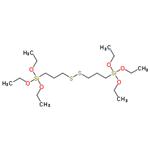
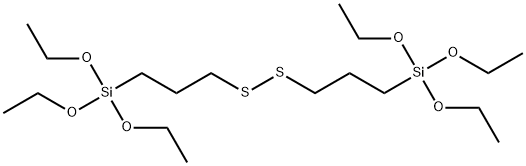
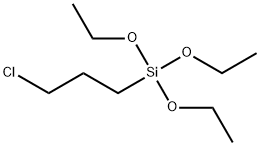
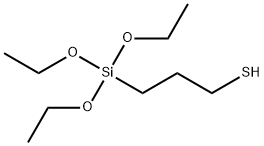
General procedure for the synthesis of (3-mercaptopropyl)triethoxysilane (MPTES), compounds (CAS:60764-86-5) and bis-[3-(triethoxysilyl)propyl]-disulfide (TESPD) from 3-chloropropyltriethoxysilane (CPTES): during the reaction, 50 wt.% NaHSO4 was added drop-wise to a NaHS solution solution. 325 g (2.69 mol) of NaHS solution with 8.2 g (0.0124 mol) of tetrabutylammonium bromide (TBAB) solution were added to a glass reactor, mixed well and heated to 75 °C. Subsequently, NaHSO4 solution was added slowly and dropwise just before the imminent addition. Next, CPTES was added. 497.8 g (2.07 moles) of CPTES was added to the reaction mixture within 8 min. the addition of NaHSO4 solution needed to be completed within 30 min. After 5 hours of reaction, the organic phase was separated and analyzed by gas chromatography (GC). The analysis showed that the product contained 2.0% wt. of CPTES, 87.6% wt. of MPTES, 2.7% wt. of TESPM, and 0.7% wt. of TESPD.Finally, the product was distilled under vacuum to yield MPTES with a purity of 95.4%, which is about 84% yield based on the amount of CPTES used.
References
[1] Patent: US6680398, 2004, B1. Location in patent: Page column 10-11
[2] Patent: US6680398, 2004, B1. Location in patent: Page column 8-9
[3] Patent: US6680398, 2004, B1. Location in patent: Page column 10
[4] Patent: US6680398, 2004, B1. Location in patent: Page column 9-10
[5] Patent: US6680398, 2004, B1. Location in patent: Page column 9


![triethoxy-[3-(3-triethoxysilylpropylsulfanyl)propyl]silane](/CAS/GIF/60764-86-5.gif)