Description
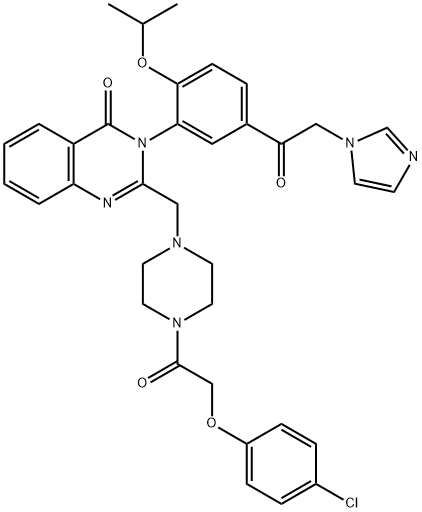
Imidazole ketone erastin is an inducer of ferroptosis. It inhibits glutamate release in human CCF-STTG1 astrocytoma cells (IC
50 = 30 nM), indicating inhibition of the system x
c- cystine/glutamate transporter. Imidazole ketone erastin increases production of lipid reactive oxygen species (ROS) in SUDHL6 diffuse large B cell lymphoma (DLBCL) cells in a concentration-dependent manner, as well as reduces glutathione (GSH) levels in these cells (IC
50 = 34 nM). It inhibits the growth of HT-1080 fibrosarcoma cells (GI
50 = 310 nM) as well as HRAS
G12V-overexpressing BJeLR cells (IC
50 = 3 nM). Imidazole ketone erastin (23 and 40 mg/kg) reduces tumor growth in an SUDHL6 mouse xenograft model.
in vivo
IKE (23-40 mg/kg; i.p. once daily for 13 d) inhibits tumor growth in mice[1].
IKE (50 mg/kg; a single i.p) depletes GSH significantly starting from 4 h, and increases in the relative abundance of free fatty acids, phospholipids, and diacylglycerols (DAG) in mice[1].
IKE (50 mg/kg) exhibits half-life (1.82, 1.31, and 0.96 h) and Cmax (19515, 11384, and 5203 ng/mL) following different administration (i.p., i.v., and p.o. respectively) in mice[1].
| Animal Model: | Male NCG mice bearing SUDHL6 subcutaneous xenografts[1] |
| Dosage: | 23, 40 mg/kg |
| Administration: | I.p. injection once daily for 13 days |
| Result: | Caused a significant decrease in tumor growth starting from day 9.
Had a weight loss starting from day 9.
|
| Animal Model: | NOD/SCID mice (12 weeks old; ~28 g weight)[1] |
| Dosage: | 50 mg/kg (Pharmacokinetic Analysis) |
| Administration: | A single i.p., i.v., and p.o. administration |
| Result: | I.p.: T1/2=1.82 h, Cmax=19515 ng/mL.
I.v.: T1/2=1.31 h, Cmax=11384 ng/mL.
P.o.: T1/2=0.96 h, Cmax=5203 ng/mL.
|
References
[1] YAN ZHANG . Imidazole Ketone Erastin Induces Ferroptosis and Slows Tumor Growth in a Mouse Lymphoma Model[J]. Cell Chemical Biology, 2019, 26 5: Pages 623-633.e9. DOI:
10.1016/j.chembiol.2019.01.008[2] MARIE-HELENE LARRAUFIE . Incorporation of metabolically stable ketones into a small molecule probe to increase potency and water solubility[J]. Bioorganic & Medicinal Chemistry Letters, 2015, 25 21: Pages 4787-4792. DOI:
10.1016/j.bmcl.2015.07.018[3] ZHIPENG LI. Ribosome stalling during selenoprotein translation exposes a ferroptosis vulnerability[J]. Nature chemical biology, 2022, 18 7: 751-761. DOI:
10.1038/s41589-022-01033-3