Description
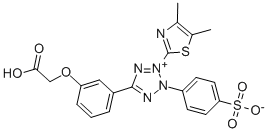
MTS reagent is one of the most common water-soluble tetrazolium reagents that are widely used to quantify cell viability by absorption spectrophotometry. A variety of tetrazolium inner salts are used for determining cell viability in proliferation assays by monitoring their color changes. Metabolically active cells reduce colorless tetrazolium inner salts into the colored formazan products that might be either soluble or insoluble in cell culture media depending on the structures of tetrazolium reagents. The conversion of tetrazolium inner salts to formazans is thought to be carried out by NAD(P)H-dependent dehydrogenase enzymes.
References
[1] MORVA MANSOURY. The edge effect: A global problem. The trouble with culturing cells in 96-well plates[J]. Biochemistry and Biophysics Reports, 2021, 26: Article 100987. DOI:
10.1016/j.bbrep.2021.100987.
[2] VICTOR AKPE. Profiling the Neoplasm Microenvironment of Silica Nanomaterial-Derived Scaffolds of Single, 2-, and 3-Composite Systems.[J]. Assay and drug development technologies, 2021, 19 3: 191-203. DOI:
10.1089/adt.2020.1020.
[3] YUTANG WANG. A Modified MTS Proliferation Assay for Suspended Cells to Avoid the Interference by Hydralazine and β-Mercaptoethanol.[J]. Assay and drug development technologies, 2021, 19 3: 184-190. DOI:
10.1089/adt.2020.1027.