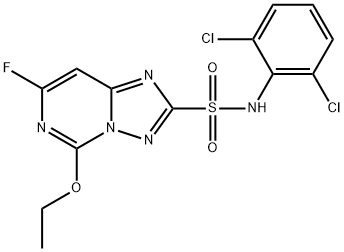
Description
Diclosulam is a soil applied herbicide. It has a low aqueous solubility, is non-volatile and, based on its chemical properties, is mobile and may leach to groundwater. It tends to be moderately persistent in soil systems. It has a low mammalian toxicity and has a high potential for bioaccumulation. It is a skin and eye irritant. It has a low level of toxicity to birds and fish but is more toxic to fish, aquatic plants, algae, earthworms and honeybees.
Uses
Diclosulam is used as a broadleaf herbicide that is used to control weeds in soybean and peanut crops. Diclosulam is applied either preplant or preemergence in order to maintain maximum control of weed growth.
Production Methods
Diclosulam is commercially produced via a convergent, multi-step synthesis that starts with the formation of the 7-fluoro-5-methoxy-[1,2,4]triazolo[1,5-c]pyrimidine core through cyclocondensation of 3-amino-1,2,4-triazole with a substituted pyrimidine precursor (e.g., diethyl 2-(methoxymethylene)malonate derivative) under basic conditions in polar solvents like DMF at 90–110 DegC. The key sulfonamide linkage is then achieved by chlorosulfonation of the core using chlorosulfonic acid, followed by nucleophilic substitution with 2,6-dichloroaniline in the presence of a base (e.g., triethylamine or pyridine) in dichloromethane.
Definition
ChEBI: Diclosulam is a sulfonamide.
Mechanism of action
Taken up by roots and foliage and translocated to growing points. Inhibits plant amino acid synthesis - acetohydroxyacid synthase AHAS.