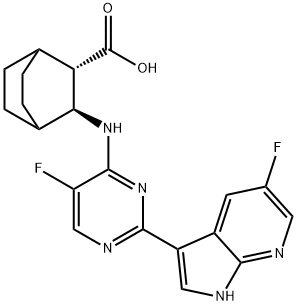
Description
Pimodivir is an inhibitor of influenza virus polymerase basic protein 2 (PB2; K
D = <0.003 μM). It also binds to glycogen synthase kinase 3β (GSK3β; K
i =
~1.6 μM) and inhibits the activity of Axl and calcium/calmodulin-dependent protein kinase IIβ (CaMKIIβ) by greater than 50% in a panel of 65 human and rat kinases. Pimodivir decreases the replication of seven adamantine- and neuraminidase inhibitor-resistant strains of influenza virus A (EC
50s = <0.15-2.8 nM in a cell-based assay). It increases the antiviral activity of oseltamivir , zanamivir , and favipiravir (T-705; ) with 50% combination index (CI
50) values of 0.58, 0.64, and 0.89, respectively, in a cell-based assay. Pimodivir increases survival in a mouse model of intranasal influenza A infection when administered at doses of 1, 3, and 10 mg/kg twice per day.
in vivo
Pimodivir (2, 6, and 20 mg/kg/day, p.o.) and GS 4071 (20 mg/kg/day) completely prevent death in the H1N1pdm virus infection in mice. Pimodivir (20 mg/kg/day) is more effective than GS 4071 (20 mg/kg/day) in improving body weight and reducing the severity of lung infection[1].
Moreover, Pimodivir (VX-787) shows 100% survival in a +48 h delay to treatment mouse influenza model at 10, 3 and 1 mpk (BID × 10 days) whereas the SOC, GS 4071, provide no survival benefit in this model at 10 mpk[3].
Pimodivir (VX-787; 1, 3, or 10 mg/kg, bid) provided complete survival, with a dose-dependent reduction in BW loss of the mice[4].
References
[1] MICHAEL P. CLARK*. Discovery of a Novel, First-in-Class, Orally Bioavailable Azaindole Inhibitor (VX-787) of Influenza PB2[J]. Journal of Medicinal Chemistry, 2014, 57 15: 6668-6678. DOI:
10.1021/jm5007275[2] RANDAL A BYRN. Preclinical activity of VX-787, a first-in-class, orally bioavailable inhibitor of the influenza virus polymerase PB2 subunit.[J]. Antimicrobial Agents and Chemotherapy, 2015: 1569-1582. DOI:
10.1128/aac.04623-14