Chemical Properties
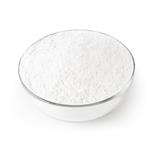
Crystalline
Uses
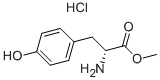
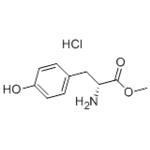
D-Tyrosine methyl ester hydrochloride is an intermediate in the synthesis of oxybutynin chloride (O868525), an inhibitor of proliferation and supresses gene expression in bladder smooth muscle cells.
Synthesis
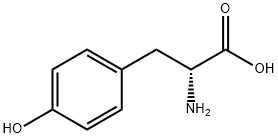
General procedure for the synthesis of methyl (R)-2-amino-3-(4-hydroxyphenyl)propanoate hydrochloride from methanol and D-tyrosine: (2R)-2-amino-3-(4-hydroxyphenyl)propanoic acid (49) (1.07 g, 5.9 mmol) was dissolved in methanol, and the reaction was completed to give methyl (2R)-2-amino-3-(4-hydroxyphenyl)propanoate (50) . The product characterization data were as follows: melting point 176°C (literature values in agreement); 1H NMR (DMSO-d6) δ: 6.82 (d, J = 8.4 Hz, 2H, ArH3' and ArH5'), 4.13 (t, J = 6.9 Hz, 1H, H2), 3.83 (s, 3H, OCH3), 3.22 (dd, J = 6.0, 14.4 Hz. 1H, 3Ha), 3.12 (dd, J = 6.9, 14.7 Hz, 1H, 3Hb). Mass spectrum (chemical ionization, positive ion mode) m/z: 196 (100%) [M+]. High Resolution Mass Spectrometry (HRMS) calculated value of C10H14NO3: 196.0974, measured value: 196.0985.
References
[1] Organic Letters, 2002, vol. 4, # 2, p. 265 - 267
[2] Organic and Biomolecular Chemistry, 2007, vol. 5, # 4, p. 636 - 643
[3] Patent: WO2006/74501, 2006, A1. Location in patent: Page/Page column 152
[4] Tetrahedron, 2008, vol. 64, # 49, p. 11270 - 11290
[5] Organic and Biomolecular Chemistry, 2005, vol. 3, # 7, p. 1233 - 1239