Synthesis
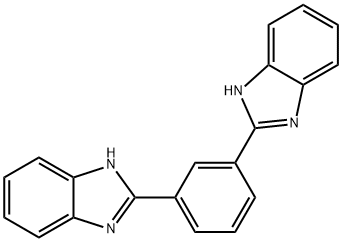
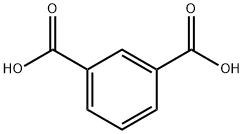
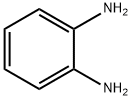
Isophthalic acid (1.130 g, 6.8 mmol) and o-phenylenediamine (1.417 g, 13.1 mmol) were used as raw materials and dissolved in 20 mL of polyphosphoric acid. The reaction mixture was stirred at 190°C for 24 hours. After completion of the reaction, the mixture was cooled to room temperature (20-25 °C) and slowly poured into 50 mL of ice water with stirring. The reaction mixture was neutralized with sodium hydroxide solution, the precipitate was collected by filtration and washed with cold water. The resulting solid was purified by recrystallization from methanol to give the white crystalline product 1,3-bis(2-benzimidazolyl)benzene (1.06 g, 57% yield, melting point 183-186 °C). The structure of the product was confirmed by 1H NMR (DMSO-d6, 400 MHz), 13C NMR (DMSO-d6, 100 MHz) and HRMS-ESI characterization.1H NMR data: δ 13.16 (s, 2H, Hc), 9.06 (t, 4Jf-d = 1.6 Hz, 1H, Hf), 8.26 (dd, 4Jd-f = 1.6 Hz, 3Jd-e = 7.8 Hz, 2H, Hd), 7.74 (t, 3Je-d = 7.8 Hz, 1H, He), 7.69 (bs, 2H, Hb'), 7.58 (bs, 2H, Hb), 7.24 (d, 3Ja-b = 4.3 Hz, 4H, HaHa').13C NMR data: δ 125.3 (Cf). 128.0 (Cd), 130.2 (Ce), 119.5-112.1 (Cb), 123.3-122.4 (Ca).HRMS-ESI (m/z): [M + H]+ calculated value C20H15N4, 311.1291; measured value, 311.1294 (error: 1 ppm).
References
[1] Organometallics, 2013, vol. 32, # 6, p. 1807 - 1814
[2] Asian Journal of Chemistry, 2013, vol. 25, # 7, p. 4013 - 4016
[3] Indian Journal of Chemistry, Section A: Inorganic, Bio-inorganic, Physical, Theoretical & Analytical Chemistry, 1993, vol. 32, # 1-3, p. 33 - 38
[4] Journal of Materials Chemistry, 2012, vol. 22, # 42, p. 22496 - 22500,5
[5] Journal of the American Chemical Society, 1992, vol. 114, # 11, p. 4230 - 4237