Chemical Properties
Pale yellow powder, soluble in organic solvents such as methanol, ethanol, and DMSO. It comes from the dried roots and rhizomes of Polygonum multiflorum and Rheum palmatum, a plant of the Polygonaceae family.
Synthesis
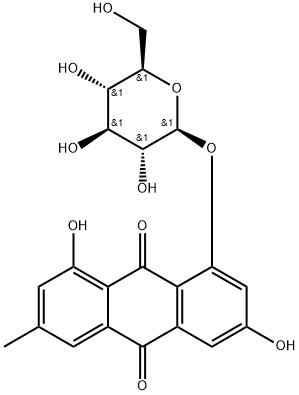
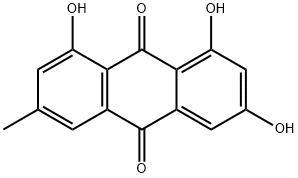
Polygonum capillaris 100g, crushed (through a 20-mesh sieve), placed in a round-bottomed flask extraction, adding 80% of the industrial ethanol hot reflux extraction, extraction time of 120 minutes, the material-liquid ratio of 1:3, extraction of three times, the combined extracts, filtration, decompression recovery to get the total extracts. The total extract of Polygonum multiflorum was suspended with water, extracted with petroleum ether and ethyl acetate, and the petroleum ether and ethyl acetate parts were recovered under reduced pressure. The ethyl acetate fraction was chromatographed on silica gel, eluted with a gradient of petroleum ether:ethyl acetate (9:1~3:2), and detected by silica gel thin-layer chromatography, and the same fractions were combined to obtain rhodopsin and rhodopsin-8-O--D-glucoside respectively, which were recrystallized from chloroform/methanol solution (5:2) to obtain 0.94g of rhodopsin, and recrystallized from chloroform/methanol solution (1:1) to obtain rhodopsin-8-O--D-glucoside. O--D-glucoside 4.05 g, the contents were 98.0% and 99.5%, respectively. Rhododendron-8-O--D-glucoside: yellow needle crystal (CHCl3-CH3OH): 422.4, 329.2, 324.8, 284.4, 230.4; soluble in alkaline solution; Borntrager reaction was positive; magnesium acetate reaction was positive; Molish reaction was positive, indicating that it was anthraquinone glycosides.