Chemical Properties
It is white needle-shaped or powdery crystals with a woody, patchouli-like aroma.
Occurrence
Has apparently not been reported to occur in nature.
Uses
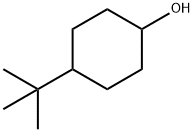
4-
tert-Butylcyclohexanol (mixture of
cis and
trans) can be used as a reactant to synthesize tris(4,4′-di-
tert-butyl-2,2′-bipyridine)(
trans-4-
tert-butylcyclohexanolato)deca-μ-oxido-heptaoxidoheptavanadium oxide cluster complex by reacting with [V
8O
20(C
18H
24N
2)
4]. It can also be used as a reactant in competitive Oppenauer oxidation experiments in the presence of zeolite BEA as a stereoselective catalyst. Only
cis-isomer is selectively converted to the corresponding ketone, whereas
trans-isomer remains unchanged.
Preparation
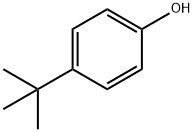
From 4-terf-butylphenol by hydrogenation(Arctander, 1969).
General Description
4-tert-Butylcyclohexanol is a soothing molecule whose special feature is to instantly decrease stinging and burning sensations. According to the manufacturer's impressive numbers, it can reduce stinging up to 78% and burning sensation by up to 80% after just 3 minutes.
It is so effective because it works at a cellular level via intercepting the signals caused by the irritation before they can reach the neuro-receptor. This means that we feel stinging and burning sensations much less and the skin's tolerance threshold is increased.
The effectiveness of SymSitive was also backed up by a comparative study. It found that both 4‐t‐Butylcyclohexanol and fellow cell-communicating, soothing molecule acetyl dipeptide‐1 cetyl ester works, but 4‐t‐Butylcyclohexanol works better.
Synthesis
Phenol and isobutylene carry out tert-butylation reaction in the presence of aluminum trichloride, and catalytic hydrogenation with Rays Nickel W7, two kinds of geometric structures can be obtained, in which the trans structure accounts for more than 70%.
References
[1] Patent: US6388149, 2002, B2. Location in patent: Page column 17
[2] RSC Advances, 2014, vol. 4, # 6, p. 2729 - 2732
[3] Comptes Rendus Hebdomadaires des Seances de l'Academie des Sciences, 1911, vol. 152, p. 609
[4] Journal of applied chemistry of the USSR, 1984, vol. 57, # 10 pt 2, p. 2138 - 2142