
53581-53-6
中文名称
(±)-2,5-二甲氧基-4-溴苯丙胺 氢溴酸盐
英文名称
(+/-)-2,5-DIMETHOXY-4-BROMO-AMPHETAMINE HYDROBROMIDE
CAS
53581-53-6
分子式
C11H17Br2NO2
分子量
355.07
MOL 文件
53581-53-6.mol
结构式
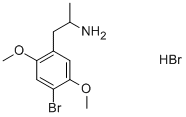
基本信息
中文别名
(±)-2,5-二甲氧基-4-溴苯丙胺 氢溴酸盐
英文别名
dob
[+/-]-DOB HYDROBROMIDE
KOUBEZAODVTFTG-UHFFFAOYSA-N
4-bromo-2,5-dimethoxyamphetamine hydrobromide
dl-2,5-dimethoxy-4-bromoamphetaminehydrobromide
dl-4-bromo-2,5-dimethoxyamphetaminehydrobromide
(+-)-2,5-dimethoxy-4-bromoamphetamine*hydrobromid
(+/-)-2,5-DIMETHOXY-4-BROMO-AMPHETAMINE HYDROBROMIDE
(+/-)-2,5-Dimethyoxy-4-bromo-amphetamine hydrobromide
dl-4-bromo-2,5-dimethoxy-alpha-methylphenethylaminehydrobromide
[+/-]-DOB HYDROBROMIDE
KOUBEZAODVTFTG-UHFFFAOYSA-N
4-bromo-2,5-dimethoxyamphetamine hydrobromide
dl-2,5-dimethoxy-4-bromoamphetaminehydrobromide
dl-4-bromo-2,5-dimethoxyamphetaminehydrobromide
(+-)-2,5-dimethoxy-4-bromoamphetamine*hydrobromid
(+/-)-2,5-DIMETHOXY-4-BROMO-AMPHETAMINE HYDROBROMIDE
(+/-)-2,5-Dimethyoxy-4-bromo-amphetamine hydrobromide
dl-4-bromo-2,5-dimethoxy-alpha-methylphenethylaminehydrobromide
安全数据
| 危险性符号(GHS) |  GHS06 |
| 警示词 | 危险 |
| 危险性描述 | H302-H310-H330 |
| 防范说明 | P264-P270-P301+P312-P330-P501-P262-P264-P270-P280-P302+P350-P310-P322-P361-P363-P405-P501-P260-P271-P284-P304+P340-P310-P320-P403+P233-P405-P501 |
| 危险品标志 | T+ |
| 危险类别码 | 26/27/28 |
| 安全说明 | 28-36/37-45 |
| 危险品运输编号 | UN 2811 6.1/PG 2 |
| WGK Germany | 3 |
| RTECS号 | SH0300000 |
| 危险等级 | 6.1(a) |
| 包装类别 | I |
| 毒性 | A hallucinogenic (psychedelic) agent that is obtained by chemical synthesis. It may catalyze severe emotional problems or psychosis in predisposed individuals, and in large doses, produces peripheral arterial spasm which, if not treated, can lead to gangrene. DOB is a potent serotonin 5-HT2 agonist, and although the underlying mechanism of action for hallucinogens is not well understood, this may be related to its actions in the CNS. Symptoms include hyperreflexia, restlessness, perceptual alterations, and illusions, including changes in touch, taste, and odor, and the thinking process is substantially altered. At high doses, it causes hallucinations, loss of contact with reality, and pain and coldness in the extremities at toxic levels. Therapeutically, peripheral arterial spasm has been treated with intraarterial tolazoline hydrochloride. Its LD50 is in mice 80 mg/kg, i.v., in rats 8 mg/kg, i.p., in dogs 4 mg/kg. i.v., and in monkeys 2 mg/kg, i.v. |