General Description
Dark red needles or red solid.
Reactivity Profile
4-NITRO-O-PHENYLENEDIAMINE(99-56-9) is incompatible with strong oxidizing agents, strong acids, strong reducing agents, acid chlorides and acid anhydrides.
Air & Water Reactions
Insoluble in water.
Fire Hazard
Flash point data for this chemical are not available; however, 4-NITRO-O-PHENYLENEDIAMINE is probably combustible.
Chemical Properties
Orange-red powder
Uses
4-Nitro-1,2-phenylenediamine is a hair dye constituent with potential mutagenic activity.
Application
4-Nitro-1,2-phenylenediamine is a hair dye constituent with potential mutagenic activity. It is used in oxidation hair dye formulations at a maximum concentration of 1.0 %, which after mixing typically in a 1:1 ratio with hydrogen peroxide just prior to use, corresponds to a concentration of 0.5% upon application.
Definition
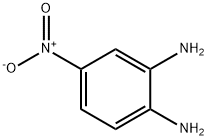
ChEBI: The primary amino compound that is 1,2-phenylenediamine (o-phenylenediamine) substituted at the 4- (para-) position by a nitro group.
Preparation
Prepared by reduction of 2,4-dinitroaniline using H2S in ammonia water.
Production Methods
Commercial production of 4-nitro-o-PDA was first reported
in the United States in 1946. Two U.S. companies were
reported to produce undisclosed amounts of the chemical in
1975. U.S. imports of 4-nitro-o-PDA were reported to be
about 1900 kg in 1973 and 1100 kg in 1975. 4-Nitro-o-PDAis
used in fur dyes, inks, and semipermanent yellow hair
coloring formulations requiring a yellow color component
that does not involve the use of hydrogen peroxide in the
color development.
Occupational exposure to 4-nitro-o-PDA may occur
through inhalation and dermal contact with this compound
at workplaces where p-PDA is produced or used. The general
population may be exposed to the compound via dermal
contact, primarily through the use of hair dyes containing
this compound.
Biochem/physiol Actions
4-Nitro-o-phenylenediamine is a direct-acting mutagen.
Purification Methods
Crystallise the diamine from water. [Beilstein 13 IV 75.]
References
[1] New Journal of Chemistry, 2015, vol. 39, # 11, p. 8498 - 8504
[2] Journal of Organic Chemistry, 1980, vol. 45, # 24, p. 4992 - 4993
[3] Patent: WO2014/149164, 2014, A1. Location in patent: Paragraph 001201
[4] Chemische Berichte, 1899, vol. 32, p. 900
[5] Chemische Berichte, 1888, vol. 21, p. 2306