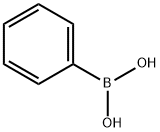
Chemical Properties
white to light yellow crystal powder
Characteristics
Phenylboronic acid and its derivatives form complexes with polyol compounds such as saccharides and poly(vinyl alcohol) (PVA). Glucose-sensitive hydrogels can be prepared by using phenylhoronic acid as a ligand for target glucose. For example. a copolymer with phenylboronic acid moieties was synthesized by copolymerization of 4V-vinyl-2-pyrrolidone (NVP) and 3-(acryl- amide)phcnylhoronic acid (PBA). The complexes between the NVP-PBA copolymer and PVA enable us to construct glucose-sensitive insulin release systems because the complexes dissociated in response to the glucose concentration.
This phenylboronic acid is soluble in water and the coupling reaction can even be carried out in water. It is compatible with many organic substituents such as esters, ketones, alcohols, etc. which would prohibit the use of Grignard reagents in coupling reactions.
Application
Due to its good water solubility and low cytotoxicity, Phenylboronic acid is used as a potential nuclear-targeted boron agent for neutron capture therapy of melanoma. Phenylboronic acid was found to have a boron concentration of 74.47 ± 12.17 ng/106 cells in B16F10 cells and 45.77 ± 5.64 ng/106 cells in the nucleus.[1]
Definition
ChEBI: Phenylboronic acid is a member of boronic acids. It is functionally related to a boronic acid.
Synthesis Reference(s)
Organic Syntheses, Coll. Vol. 4, p. 68, 1963
The Journal of Organic Chemistry, 49, p. 5237, 1984
DOI: 10.1021/jo00200a045
General Description
Phenylboronic acid (PBA) is an organoboronic acid. It behaves as a molecular receptor that can attach to compounds containing cis-diol group. Microwave-assisted Suzuki coupling of aryl chlorides with phenylboronic acid in the presence of Pd/C (catalyst) and water (solvent) has been described. Palladium-catalyzed cross-coupling reaction of phenylboronicacid with haloarenes to afford biaryls has been reported.
Safety Profile
Poison by intravenous andintraperitoneal routes. Moderately toxic by ingestion.Mildly toxic by skin contact. When heated to decomposition it emitsacrid smoke and irritating fumes.
Toxicity evaluation
Acute toxicity studies with Phenylboronic acid have shown that Rat has an oral LD50 of 740 mg/kg. it is harmful if swallowed and may be irritating to the skin, eyes and respiratory tract.
References
[1] CHEN J, LI Y, GAN X, et al. Unlocking the potential: phenylboronic acid as a nuclear-targeting boron agent for neutron capture therapy[J]. Medical Oncology, 2024, 1110 1. DOI:10.1007/s12032-024-02351-3.