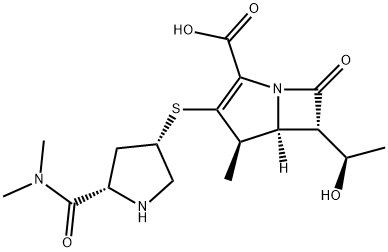
Manufacturing Process
3.10 g of trans-1-(p-nitrobenzyloxycarbonyl)-4-hydroxy-L-proline and 1.10 g of triethylamine were dissolved in 40 ml of dried tetrahydrofuran, and a solution of 1.20 g of ethyl chloroformate in 10 ml of dried tetrahydrofuran was added dropwise thereto at -25-35°C. After stirring at the same temperature for 50 min, 10 ml of concentrated aqueous ammonia was added dropwise to the mixture at -25-40°C. The temperature was then gradually elevated to room temperature, and the reaction mixture was stirred for 1 hour, followed by concentration under reduced pressure. To the residue were added 20 ml of water and 50 ml of diethyl ether. After ice-cooling, the thus formed white crystals were separated by filtration, washed successively with cool water and cool diethyl ether, and dried under reduced pressure to yield trans-1-(pnitrobenzyloxycarbonyl)-4-hydroxy-L-prolineamide. Melting point: 163.3-164.0°C.
A solution of 1.89 g of methanesulfonyl chloride in 10 ml of dried
tetrahydrofuran was added dropwise to a suspension of 2.32 g of trans-1-(pnitrobenzyloxycarbonyl)-4-hydroxy-L-prolineamide and 1.67 g of triethylamine
in 40 ml of dried tetrahydrofuran at room temperature. After stirring for 1
hour, the reaction mixture was concentrated under reduced pressure, and to
the residue were added 30 ml of water and 30 ml of diethyl ether. After
cooling, the resulting white crystals were separated by filtration, washed
successively with cool water and cool diethyl ether and dried under reduced
pressure to obtain trans-1-(p-nitrobenzyloxycarbonyl)-4-methanesulfonyloxyL-prolineamide. Melting point: 149.5-151°C.
A solution of 642 mg of thioacetic acid in 14 ml of dried dimethylformamide
was added to a suspension of 374 mg of 50% sodium hydride in 13 ml of
dried dimethylformamide in a nitrogen stream, followed by stirring at room
temperature for 25 minutes. To the mixture were added 975 mg of sodium
iodide and then a solution of 2.52 g of trans-1-(p-nitrobenzyloxycarbonyl)-4-
methanesulfonyloxy-L-prolineamide in 12 ml of dried dimethylformamide, and
the resulting mixture was heated to 70°C for 6 hours while stirring. The
reaction mixture was poured into a cool aqueous solution of sodium chloride
and extracted with benzene. The extract was washed successively with a 10%
aqueous solution of sodium sulfate and a sodium chloride aqueous solution,
dried over sodium sulfate and distilled off to remove the solvent. The resulting
crude crystals were washed with a warm mixed solvent of tetrahydrofuran and
benzene to obtain (2S,4S)-1-(p-nitrobenzyloxycarbonyl)- 2-carbamoyl-4-
acetylthio-L-prolineamide. Melting point: 168.5-169.5°C.
950 mg of (2S,4S)-1-(p-nitrobenzyloxycarbonyl)-2-carbamoyl-4-
acetylthiopyrrolidine was dissolved in 95 ml of methanol, and 2.59 ml of a 1 N
aqueous solution of sodium hydroxide was added thereto at room temperature
in an argon stream, followed by stirring at that temperature for 15 min. The
reaction mixture was neutralized with 2.59 ml of a 1 N aqueous solution of
hydrochloric acid and distilled off under reduced pressure to remove the
methanol. The thus precipitated crystals were filtered and washed with water
to obtain (2S,4S)-1-(p-nitrobenzyloxycarbonyl)-2-carbamoyl-4-
mercaptopyrrolidine. Melting point: 158-162°C.
To 1.33 g (20 mM) of activated zinc was added 20 ml of dried
tetrahydrofuran, and 8.8 ml of a 15% n-hexane solution of diethylaluminium
chloride was added thereto in a nitrogen stream under ice-cooling. A solution
prepared by dissolving 1.49 g (5.2 mM) of (3R,4R)-4-acetoxy-3-[(R)-1-(tbutyldimethylsilyloxy)ethyl]-2-azetidinone and 3.73 g (15.3 mM) of benzyl-αbromopropionate in 13.3 ml of dried tetrahydrofuran was added dropwise to
the mixture over a period of 30 to 40 min, followed by stirring for 1 hours.
Under ice-cooling, 2.8 ml of pyridine, 13.2 ml of water, 26.5 ml of ethyl
acetate and 13.2 ml of a 1 N hydrochloric acid aqueous solution were
successively added thereto, and the resulting mixture was filtered using
Celite. The filtrate was washed with water, and the organic layer was dried
over sodium sulfate and distilled off to remove the solvent. The resulting oily
residue was subjected to silica gel column chromatography to obtain an
isomeric mixture of 4-(1-benzyloxycarbonyl)ethyl-3-[(R)-1-(tbutyldimethylsilyloxy)ethyl]-2-azetidinone.
The isomeric mixture was separated into each compound by Lober column
chromatography using silica gel and 1.5% isopropanol/n-hexane as an eluent
to obtain the compound (1a) and the compound (1b) as oily substances.
200 mg of 4-(1-benzyloxycarbonyl)ethyl-3-[(R)-1-(t-butyl-dimethylsilyloxy)
ethyl]-2-azetidinone (1a) was dissolved in 2 ml of dried dimethylformamide.
126 mg of triethylamine was added to the resulting solution, and then 151 mg
of t-butyldimethylsilyl chloride was added thereto, followed by stirring at room
temperature overnight. The reaction mixture was diluted with ethyl acetate,
washed with water, dried over sodium sulfate and purified by silica gel
chromatography to obtain 4-(1-benzyloxycarbonyl)ethyl-3-[(R)-1-(tbutyldimethylsilyloxy)ethyl]-1-(t-butyldimethylsilyl)-2-azetidinone (2a).
184 mg of (2a) was dissolved in 4 ml of methanol, and the resulting solution
was stirred together with 20 mg of 10% palladium-on-carbon at an
atmospheric pressure of hydrogen for 2 hours. The catalyst was removed by
filtration, and the filtrate was concentrated under reduced pressure to obtain
4-(1-carboxy)ethyl-3-[(R)-1-(t-butyldimethylsilyloxy)ethyl]-1-(tbutyldimethylsilyl)-2-azetidinone (3a).
(4R,5R,6S,8R)-p-Nitrobenzyl-4-methyl-6-(1-hydroxyethyl)-1-azabicyclo
[3.2.0]-hept-3,7-dione-2-carboxylate was obtained from 170 mg of 4-(1-
carboxy)ethyl-3-[(R)-1-(t-butyldimethylsilyloxy)ethyl]-1-(t-butyldimethylsilyl)-
2-azetidinone (3a) according to the method described in Japanese Patent
Application OPI No. 26887/83, pages 64-65.
(a) 53 mg of (4R,5R,6S,8R)-p-nitrobenzyl-4-methyl-6-(1-hydroxyethyl)-1-
azabicyclo[3,2,0 ]-hept-3,7-dione-2-carboxylate was dissolved in 5 ml of dry
acetonitrile, and 57 mg of diisopropylethylamine and then 43 mg of diphenyl
chlorophosphate were added thereto. After stirring for 2.5 hours, 57 mg of
[2S,4S]-1-p-nitrobenzyloxycarbonyl-2-dimethylaminocarbonyl-4-
mercaptopyrrolidine was added to the mixture, followed by stirring for 1 hour.
The reaction solution was diluted with ethyl acetate, washed with water, dried
over magnesium sulfate and the solvent was distilled off. The residue was
purified by silica gel thin layer chromatography to obtain 35 mg of
(4R,5S,6S,8R,2'S,4'S)-p-nitrobenzyl-3-[4-(1-p-nitrobenzyloxycarbonyl-2-
dimethylaminecarbonyl)pyrrolidinylthio]-4-methyl-6-(1-hydroxyethyl)-1-
azabicyclo[3,2,0]-hept-2-ene-7-one-2-carboxylate.
(b) 25 mg of (4R,5S,6S,8R,2'S,4'S)-p-nitrobenzyl-3-[4-(1-pnitrobenzyloxycarbonyl-2-dimethylaminecarbonyl)pyrrolidinylthio]-4-methyl-6-
(1-hydroxyethyl)-1-azabicyclo[3,2,0]hept-2-ene-7-one-2-carboxylate was
dissolved in a mixture of 1.9 ml of tetrahydrofuran and 0.3 ml of ethanol, and
the mixture was hydrogenated in a morpholinopropanesulfonic acid buffer
solution (pH = 7.0, 1.9 ml) under atmospheric pressure of hydrogen for 3
hours at room temperature in the presence of 30 mg of 10% palladiumcarbon, which had been activated in hydrogen atmosphere for 1 hour followed
by washing with water. After filtering off the catalyst, tetrahydrofuran and
ethanol were distilled off under reduced pressure, and the residual solution
was washed with ethyl acetate. The aqueous layer was again distilled under
reduced pressure to remove organic solvents, and the residual solution was
subjected to polymer chromatography (CHP-20P) to obtain
(4R,5S,6S,8R,2'S,4'S)-3-[4-(2-dimethylaminecarbonyl)pyrrolidinylthio]-4-
methyl-6-(1-hydroxyethyl)-1-azabicyclo[3,2,0]hept-2-ene-7-one-2-carboxylic acid from the fraction eluted with water.
References
[1] edwards j r. meropenem: a microbiological overview [j]. journal of antimicrobial chemotherapy, 1995, 36 (suppl a): 1-17.
[2] jones r n, barry a l, tbornsberry c. in-vitro studies of meropenem [j]. journal of antimicrobial chemotherapy, 1989, 24 (suppl a): 9-29.
[3] yang y, bhachech n, bush k. biochemical comparison of imipenem, meropenem and biapenem: permeability, binding to penicillin-binding proteins, and stability to hydrolysis by β-lactamases [j]. journal of antimicrobial chemotherapy, 1995, 35 (1): 75-84.
[4] drusano g l, hutchison m. the pharmacokinetics of meropenem [j]. scandinavian journal of infectious diseases.supplementum, 1994, 96: 11-16.