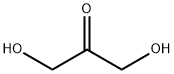
Chemical Properties
Dihydroxyacetone has a characteristic sweet, cooling aroma.
Chemical Properties
white powder
Occurrence
A derivative of naturally occurring starch
Application
1,3-Dihydroxyacetone (DHA) is a common cosmetic material and food additive, and is also a versatile building block for the organic synthesis of a variety of fine chemicals. DHA is believed to be involved in weight gain and fat loss, antioxidant activity, and endurance improvement, and provides a safe and effective treatment option for recurrent vitiligo. DHA has also been developed as a highly efficient electrochemiluminescent co-reactant with Ru(bpy)32+. It is approximately 25 times more efficient than the well-known co-reactant sodium oxalate. The high electrochemiluminescence efficiency allows for sensitive detection of DHA without any derivatization. The electrochemiluminescence method exhibits two linear electrochemiluminescence responses in the range of 5.0–500 μM and 500 μM–6.0 mM, with a detection limit of 1.79 μM.[2]
Definition
ChEBI: A ketotriose consisting of acetone bearing hydroxy substituents at positions 1 and 3. The simplest member of the class of ketoses and the parent of the class of glycerones.
Preparation
Usually produced commercially from Bacillus macerans or Bacillus circulans fermentation of starch or starch
hydrolysate
Taste threshold values
Reported to have a taste threshold value lower than that of sucrose with a detection level of 3.9 to 27 ppm
and a recognition level of 11 to 52 ppm.
General Description
Dihydroxyacetone (DHA) is a browning ingredient widely used in cosmetics such as sunless tanning formulations. It participates in a chemical staining reaction called Milliard reaction in which it reacts with the amino groups of proteins to result in a mixture of high molecular weight pigments.
Pharmaceutical secondary standards for application in quality control, provide pharma laboratories and manufacturers with a convenient and cost-effective alternative to the preparation of in-house working standards.
Safety Profile
Mutation data reported. When heated to decompositionit emits acrid smoke and irritating vapors.
Safety
Cells that were treated with 1,3-Dihydroxyacetone (DHA) showed dose- and time-dependent changes that included cytoplasmic budding, chromatin condensation, and cell detachment. There was a significant decrease in cell proliferation after 24 hours of DHA exposure. After exposure to a 5% DHA solution for 21 days, epidermal thickening and dermatitis of the skin were noted in laboratory animals. After 42 days of treatment with the same solution, hyperplastic and dyskeratotic changes and moderate inflammatory reactions were seen. Long-lasting topical tanning products contain the sugars DHA or erythrulose, which cause a "Maillard reaction" when contacting proteins in the outer layers of the stratum corneum and epidermis. This reaction happens when free amino acids from skin proteins combine with DHA in the stratum corneum. This combination creates the tanned appearance of skin. Results are generally seen within a few hours of application. UV light exposure is not needed to initiate this chemical reaction[1].
References
[1] Gallagher, Mary. “Exposureto Dihydroxyacetone in Sunless Tanning Products.”Journal of the Dermatology Nurses'Association 10(1): 11-17.