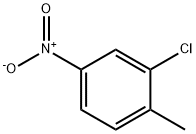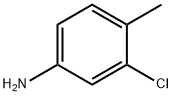
95-74-9
| Name | 3-Chloro-4-methylaniline |
| CAS | 95-74-9 |
| EINECS(EC#) | 202-446-3 |
| Molecular Formula | C7H8ClN |
| MDL Number | MFCD00007773 |
| Molecular Weight | 141.6 |
| MOL File | 95-74-9.mol |
Chemical Properties
| Appearance | The chloromethylanilines are colorless or white crystalline solids or liquids, some have a mild fishy odor. |
| Melting point | 25 °C |
| Boiling point | 237-238 °C(lit.) |
| density | 1.17 |
| vapor pressure | 4.973-8.666Pa at 25℃ |
| refractive index | n |
| Fp | 212 °F |
| storage temp. | 2-8°C |
| solubility | Chloroform, Methanol (Slightly) |
| form | powder to lump to clear liquid |
| pka | pK1: 4.05(+1) (25°C) |
| color | White or Colorless to Light orange to Yellow |
| Specific Gravity | 1.167 |
| Stability: | Stable. Combustible. Incompatible with strong oxidizing agents, acid chlorides, acids, acid anhydrides, chloroformates, reducing agents. |
| Water Solubility | 1 g/L (20 ºC) |
| BRN | 636511 |
| Henry's Law Constant | 4.9×100 mol/(m3Pa) at 25℃, HSDB (2015) |
| InChI | 1S/C7H8ClN/c1-5-2-3-6(9)4-7(5)8/h2-4H,9H2,1H3 |
| InChIKey | RQKFYFNZSHWXAW-UHFFFAOYSA-N |
Safety Data
| Symbol(GHS) |   GHS06,GHS09 |
| Signal word | Danger |
| Hazard statements | H301+H311-H315-H317-H319-H410 |
| Precautionary statements | P273-P280-P301+P310+P330-P302+P352+P312-P305+P351+P338 |
| Hazard Codes | T,N,Xn |
| Risk Statements | |
| Safety Statements | |
| RIDADR | UN 2239 6.1/PG 3 |
| WGK Germany | 2 |
| RTECS | XU5111000 |
| TSCA | Yes |
| REACH Registrations | Active |
| HazardClass | 6.1 |
| PackingGroup | III |
| HS Code | 29214300 |
| Storage Class | 6.1C - Combustible acute toxic Cat.3 toxic compounds or compounds which causing chronic effects |
| Hazard Classifications | Acute Tox. 3 Dermal Acute Tox. 3 Oral Aquatic Acute 1 Aquatic Chronic 1 Eye Irrit. 2 Skin Irrit. 2 Skin Sens. 1 |
| Safety Profile | |
| Hazardous Substances Data | 95-74-9(Hazardous Substances Data) |