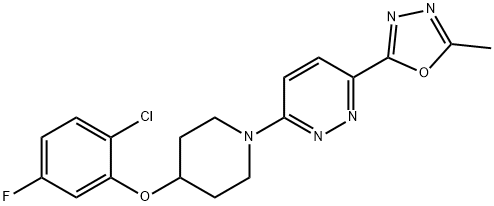
[1] PAUL COHEN. Role for Stearoyl-CoA Desaturase-1 in Leptin-Mediated Weight Loss[J]. Science, 2002, 297 5579. DOI:
10.1126/science.1071527[2] PAWEL DOBRZYN. Loss of stearoyl-CoA desaturase 1 inhibits fatty acid oxidation and increases glucose utilization in the heart.[J]. American journal of physiology. Endocrinology and metabolism, 2008: E357-64. DOI:
10.1152/ajpendo.00471.2007[3] MAKOTO MIYAZAKI. Hepatic stearoyl-CoA desaturase-1 deficiency protects mice from carbohydrate-induced adiposity and hepatic steatosis.[J]. Cell metabolism, 2007, 6 6: 484-496. DOI:
10.1016/j.cmet.2007.10.014[4] GANG LIU. Discovery of Potent, Selective, Orally Bioavailable Stearoyl-CoA Desaturase 1 Inhibitors[J]. Journal of Medicinal Chemistry, 2007, 50 13: 3086-3100. DOI:
10.1021/jm070219p[5] BENJAMIN M VINCENT. Inhibiting Stearoyl-CoA Desaturase Ameliorates α-Synuclein Cytotoxicity.[J]. Cell reports, 2018: 2742-2754.e31. DOI:
10.1016/j.celrep.2018.11.028[6] JUNMEI YI. Oncogenic activation of PI3K-AKT-mTOR signaling suppresses ferroptosis via SREBP-mediated lipogenesis.[J]. Proceedings of the National Academy of Sciences of the United States of America, 2020: 31189-31197. DOI:
10.1073/pnas.2017152117[7] LESLIE MAGTANONG . Exogenous Monounsaturated Fatty Acids Promote a Ferroptosis-Resistant Cell State[J]. Cell Chemical Biology, 2019, 26 3: Pages 420-432.e9. DOI:
10.1016/j.chembiol.2018.11.016