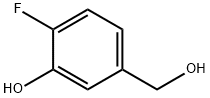
The general procedure for the synthesis of 4-fluoro-3-hydroxybenzyl alcohol from methyl 4-fluoro-3-hydroxybenzoate was as follows: LiBH4 (2.37 g, 109 mmol) was suspended in THF (50 mL) at room temperature, followed by the addition of methyl 4-fluoro-3-hydroxybenzoate (5.0 g, 27.2 mmol). The reaction mixture was stirred under reflux conditions for 24 hours. After completion of the reaction, the mixture was concentrated. The residue was partitioned between EtOAc (100 mL) and 1N HCl (100 mL). The aqueous layer was extracted with EtOAc (50 mL × 2) and the combined organic layers were washed with brine, dried over MgSO4 and concentrated. The residue was purified by fast column chromatography to afford 4-fluoro-3-hydroxybenzyl alcohol (2.76 g, 19.4 mmol, 66% yield) as a white solid.1H NMR (CDCl3) δ: 7.09-7.00 (2H, m), 6.88-6.82 (1H, m), 5.24 (1H, d, J = 4.0 Hz), 4.60 (2H, s) , 1.68 (1H, brs).