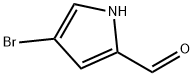
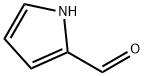
General procedure for the synthesis of 4-bromo-1H-pyrrole-2-carbaldehyde from 2-pyrrolecarboxaldehyde: To a stirred solution of 1H-pyrrole-2-carbaldehyde (1 g, 10.52 mmol) in acetonitrile (10 mL) was slowly added N-bromosuccinimide (1.872 g, 10.52 mmol) at 0 °C. The reaction mixture was continued to be stirred at 0 °C for 15 min. Upon completion of the reaction, water was added to quench the reaction and the mixture was extracted with ether. The organic layers were combined, dried over anhydrous sodium sulfate and subsequently concentrated under reduced pressure. The crude product was recrystallized by mixed cyclohexane/ethanol solvent to afford 4-bromo-1H-pyrrole-2-carbaldehyde (41) as white crystals (1.125 g, 61% yield). The product characterization data were as follows: rf = 0.22 (dichloromethane as unfolding agent); melting point: 121-122 °C; 1H NMR (400 MHz, [D6]DMSO): δ 7.12 (m, 1H), 7.41 (m, 1H), 9.48 (s, 1H), 12.51 (bs, 1H); 13C NMR (100 MHz, [D6] DMSO): δ 97.0, 120.8, 126.5, 132.9, 179.1; IR (KBr): ν 3238, 3108, 2926, 2860, 1655, 1380, 1357, 1177, 1104, 920, 827, 771, 744, 598 cm-1; MS (ESI) m/z 173.9- 175.9 [M+H]+.