Uses
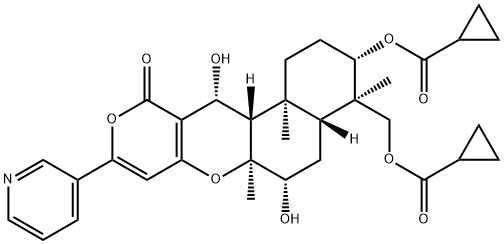
Afidopyropen (ME-5343) is an Afidopyropen targets sucking insects such as whiteflies, aphids, and leafhoppers by acting on the Nanchung (Nan) and Inactive (Iav) encoding gene of insects, and affecting TRPV channel. Afidopyropen can be used for many crops for its degradability[1].
Definition
ChEBI: Afidopyropen is an organic heterotetracyclic compound that is 1,3,4,4a,5,6,6a,12,12a,12b-decahydro-2H,11H-benzo[f]pyrano[4,3-b]chromen-11-one which is substituted by methyl groups at positions 4, 6a, and 12b; hydroxy groups at positions 3, 6, and 9; and a cyclopropycarbonyloxymethyl group and a cyclopropylcarbonyloxy group at positions 17 and 18 respectively, and a pyridin-3-yl group at position 14 (the (3S,4R,4aR,6S,6aS,12R,12aS,12bS stereoisomer). It is an insecticide that is effective against sucking insects on fruit, vegetables and nuts. It has a role as an insecticide, an agrochemical and a TRPV channel modulator. It is a cyclopropanecarboxylate ester, a member of pyridines, an organic heterotetracyclic compound and a secondary alcohol.
Production Methods
Afidopyropen is produced commercially as a synthetic derivative of natural pyropenes. Its production involves fermentation-based generation of the pyropene core structure from actinomycete microorganisms, followed by semisynthetic chemical modification to introduce functional groups that enhance insecticidal activity and stability.