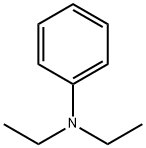
General Description
A colorless to yellow liquid with a fishlike odor, that is strongly corrosive. Irritating to skin, eyes and mucous membranes and moderately toxic by inhalation, absorption and ingestion. Flash point 185°F. Used in dyes and in the production of organic chemicals.
Reactivity Profile
N,N-DIETHYLANILINE(91-66-7) neutralizes acids in exothermic reactions to form salts plus water. May be incompatible with isocyanates, halogenated organics, peroxides, phenols (acidic), epoxides, anhydrides, and acid halides. Flammable gaseous hydrogen may be generated in combination with strong reducing agents, such as hydrides.
Air & Water Reactions
Insoluble in water.
Health Hazard
May be fatal if inhaled, swallowed or absorbed through the skin. Vapor or mist is irritant to the eyes, mucous membranes, upper respiratory tract; causes skin irritation. Absorption into the body leads to the formation of methemoglobin which, in sufficient concentration, may cause cyanosis. Onset may be delayed 2-4 hours or longer. Exposure can cause nausea, dizziness, headache, damage to the eyes, and blood effects.
Fire Hazard
Special Hazards of Combustion Products: Emits toxic fumes under fire conditions.
Description
Diethyl aniline is a colorless to yellow liquid.Molecular weight=149.26; Boiling point=216℃; Flashpoint=85℃; Autoignition temperature=630℃. HazardIdentification (based on NFPA-704 M Rating System): Health3, Flammability 2, Reactivity 0. Slightly soluble in water.
Chemical Properties
light yellow liquid
Chemical Properties
N,N-Diethylaniline is a pale yellow liquid. It is
slightly soluble in water (1.40 g/L at 12°C), and soluble in
alcohol and ether.
Synthesis Reference(s)
Chemistry Letters, 15, p. 293, 1986
Journal of the American Chemical Society, 95, p. 3038, 1973
DOI: 10.1021/ja00790a064
Flammability and Explosibility
Nonflammable
Potential Exposure
Diethyl aniline is used in organic synthesis and as a diestuff intermediate.
First aid
If this chemical gets into the eyes, remove anycontact lenses at once and irrigate immediately for at least15 min, occasionally lifting upper and lower lids. Seek medical attention immediately. If this chemical contacts theskin, remove contaminated clothing and wash immediatelywith soap and water. Seek medical attention immediately. Ifthis chemical has been inhaled, remove from exposure,begin rescue breathing (using universal precautions, including resuscitation mask) if breathing has stopped and CPR ifheart action has stopped. Transfer promptly to a medicalfacility. When this chemical has been swallowed, get medical attention. Give large quantities of water and inducevomiting. Do not make an unconscious person vomit.Note to physician: Treat for methemoglobinemia.Spectrophotometry may be required for precise determination of levels of methemoglobinemia in urine.
storage
Color Code—Blue: Health Hazard/Poison: Storein a secure poison location. Prior to working with DEA youshould be trained on its proper handling and storage.Diethyl aniline must be stored to avoid contact with strongoxidizers (such as chlorine, bromine, and fluorine) andstrong acids since violent reactions occur. Store in tightlyclosed containers in a cool, well-ventilated area away fromstrong acids (such as hydrochloric, sulfuric, and nitric) anddirect sunlight.
Shipping
N,N-Diethylaniline must be labeled:“POISONOUS/TOXIC MATERIALS.” It falls in HazardClass 6.1 and Packing Group III.
Purification Methods
Reflux the base for 4hours with half its weight of acetic anhydride, then fractionally distil it under reduced pressure (b 92o/10mm). [Beilstein 12 IV 252.]
Incompatibilities
Forms explosive mixture with air.Violent reaction with strong oxidizers, halogens.Incompatible with acids, organic anhydrides, isocyanates,aldehydes.