Description
Discovered in the 1940s, diethylcarbamazine (DEC) has proven to be especially effective as a
filaricidal agent. The incidence of filariasis among American troops during World War II
necessitated a search for drugs with an antifalarial spectrum of activity. The once-popular
piperazine also was discovered during these initial screenings. Although chemically similar, the
activity again helminths is quite different. Piperazine is active against nematodes, whereas DEC is
active against falaria and microfalaria.
Chemical Properties
Crystals. Melting point 47-49°C, boiling point 108.5-111°C (0.4kPa).
Originator
Hetrazan,Lederle,US,1949
Definition
ChEBI: Diethylcarbamazine is a N-methylpiperazine and a N-carbamoylpiperazine.
Manufacturing Process
To 50 cc of water was added 18 grams of 1-methylpiperazine dihydrochloride
and 8.34 grams of sodium hydroxide. When solution had been effected the
beaker was cooled to 10°C and with stirring, 4.17 grams of sodium hydroxide
dissolved in 15 cc of water and 14 grams of diethyl carbamyl chloride were
added simultaneously. When all had been added, the solution was extracted 3
times with ether which was then dried and filtered. The ether solution was
saturated with dry hydrogen chloride. A yellow gum appeared which on
trituration gave a white, hygroscopic solid which was filtered and dried in a
drying pistol. The N,N-diethyl-4-methyl-1-piperazine-carboxamide
hydrochloride had a melting point of 150°-155°C.
If the compound itself is desired, the salt is dissolved in water and the
solution saturated with a mild alkali such as potassium carbonate. The product
is then extracted with chloroform, dried, and after removal of the chloroform,
distilled.
Therapeutic Function
Anthelmintic
Antimicrobial activity
Useful activity is restricted to filarial worms. It is adulticidal
and microfilaricidal against Loa loa. Against Wuchereria bancrofti
and Brugia malayi it is predominantly microfilaricidal,
but slowly kills adult worms. It kills microfilariae, but not
adults, of Onchocerca volvulus.
Pharmaceutical Applications
A carbamyl derivative of piperazine formulated as the citrate.
It is readily soluble in water and slightly hygroscopic.
Mechanism of action
Although studied extensively, the mechanism of action of DEC remains unknown.
Diethylcarbamazine appears to be the active form of the drug, with a very rapid onset of action
(within minutes), but of interest is the fact that the drug is inactive in vitro, suggesting that
activation of a cellular component is essential to the filaricidal action. Three mechanisms have
been suggested. The first is involvement of blood platelets triggered by the action of filarial
excretory antigens. A complex reaction is thought to occur between the drug, the antigen, and
platelets. Although these authors were unable to show a direct action of the drug on the
microfalaria, a more recent study showed that DEC produced morphological damage to the
microfalaria. The damage consisted of the loss of the cellular sheath, exposing antigenic
determinants to immune defense mechanisms. Severe damage then occurred to microfalaria
organelles, leading to death. The second is inhibition of microtubule polymerization and
disruption of preformed microtubules. The third is interference with arachidonic acid
metabolism. Diethylcarbamazine is known to have anti-inflammatory action, which appears to
involve blockage at cyclooxygenase and leukotriene A4 synthase (leukotriene synthesis). This
action appears to alter vascular and cellular adhesiveness and cell activation. This latter action
would suggest a possible relationship between the first and third mechanism.
Pharmacokinetics
Oral absorption: >90%
Cmax 200 mg: 1.5–2 mg/L after 2 h
Plasma half-life: c. 6–12 h
Volume of distribution: 107–371 L
Plasma protein binding: Very low
Like piperazine (to which it is related), diethylcarbamazine
is rapidly and completely absorbed. About half the dose is
excreted unchanged in the urine; the rest is metabolized and
eliminated by renal and extrarenal routes.
Clinical Use
Filariasis
It has also been used for visceral larva migrans, but experience
is limited and there is little evidence of its efficacy.
Synthesis
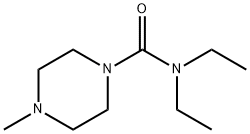
Diethylcarbamazine, N, N-diethyl-4-methyl-1-piperazincarboxamide
(38.1.13), is made by acylating 1-methylpiperazine with diethylcarbamoylchloride.

Metabolism
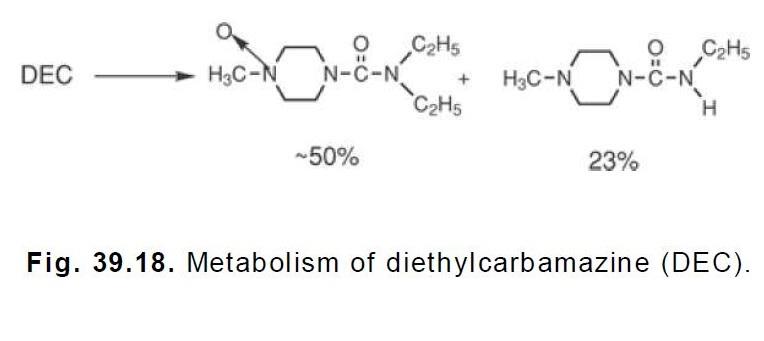
The metabolism of DEC leads to the compounds shown in Figure 39.18 plus trace amounts of
methylpiperazine and piperazine. Nearly all of the metabolites appear in the urine. As much as 10
to 20% of the drug is excreted unchanged. As indicated by the rapid action of the drug, it would
appear that none of the metabolites are involved in the therapeutic action of DEC.