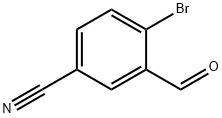
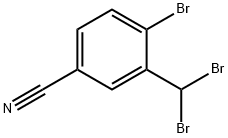
General procedure for the synthesis of 2-bromo-5-cyanobenzaldehyde from 4-bromo-3-(dibromomethyl)benzonitrile: To a solution of 4-bromo-3-(dibromomethyl)benzonitrile (18 g, 0.051 mol) in ethanol (EtOH; 200 mL) was added slowly and dropwise to an aqueous (H2O) solution of silver nitrate (AgNO3; 21.8 g, 0.128 mol) at 60 °C; 100 mL) solution. The reaction temperature was then raised to 75 °C and the reaction mixture was stirred under reflux conditions for 6 hours. Upon completion of the reaction, the mixture was cooled to room temperature, the reaction mixture was filtered and the filter cake was washed with ethyl acetate (EtOAc). The combined organic layers were washed sequentially with water (H2O) and brine, dried over anhydrous sodium sulfate (Na2SO4) and concentrated under reduced pressure. The yellow crude product obtained was ground with hexane to give 2-bromo-5-cyanobenzaldehyde as a yellow solid (8.5 g, 85% yield): melting point 138-141 °C; NMR hydrogen spectrum (400 MHz, CDCl3) δ 10.35 (d, J = 0.6 Hz, 1H), 8.18 (dd, J = 2.1, 0.5 Hz, 1H), 7.86- 7.79 (m, 1H), 7.74-7.65 (m, 1H); electron bombardment mass spectrometry (EIMS) m/z 210.