
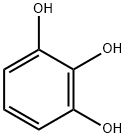
87-66-1

Name Pyrogallol
CAS 87-66-1
EINECS(EC#) 211-207-2
Molecular Formula C6H6O3
MDL Number MFCD00008358
Molecular Weight 126.11
MOL File 87-66-1.mol

Chemical Properties

Appearance white crystalline solid
Melting point  43-47 °C(lit.)
Boiling point  309 °C
bulk density 600kg/m3
density  1.112 g/mL at 25 °C(lit.)
vapor density  4.4 (vs air)
vapor pressure  10 mm Hg ( 167.7 °C)
refractive index  n20/D 1.387
Fp  >230 °F
storage temp.  Desiccate at RT
solubility  water: soluble
form  Very Fine Crystalline Powder
pka pK1:9.03(0);pK2:11.63(+1) (25°C)
color  White
PH 4-5 (50g/l, H2O, 20℃)
Stability: Stable, but decolourises in light. Combustible. Incompatible with strong oxidising agents, alkalies, metal oxides, ammonia, antipyrine, phenol, iodine, lime water, menthol, potassium permanganate, strong bases.
Water Solubility  400 g/L (25 ºC)
Sensitive  Light Sensitive
Detection Methods HPLC,NMR
Merck  14,8000
BRN  907431
Henry's Law Constant 6.3×10⁴ mol/(m3Pa) at 25℃, HSDB (2015)
Major Application pharmaceutical (small molecule)
Cosmetics Ingredients Functions HAIR DYEING
InChI 1S/C6H6O3/c7-4-2-1-3-5(8)6(4)9/h1-3,7-9H
Contact allergens
Pyrogallol belongs to the phenols group. It is an old photograph developer and a low sensitizer in hair dyes.
InChIKey WQGWDDDVZFFDIG-UHFFFAOYSA-N
SMILES Oc1cccc(O)c1O
LogP -0.47
CAS DataBase Reference 87-66-1(CAS DataBase Reference)
NIST Chemistry Reference 1,2,3-Benzenetriol(87-66-1)
Storage Precautions Light sensitive;Store under nitrogen;Air sensitive
EPA Substance Registry System 87-66-1(EPA Substance)

Safety Data

Symbol(GHS)  Exclamation Mark (GHS07)Health Hazard (GHS08)
GHS07,GHS08
Signal word  Warning
Hazard statements  H302+H312+H332-H341-H412
Precautionary statements  P273-P280-P301+P312-P302+P352+P312-P304+P340+P312-P308+P313
Hazard Codes  Xn
Risk Statements 
R20/21/22:Harmful by inhalation, in contact with skin and if swallowed .
R52/53:Harmful to aquatic organisms, may cause long-term adverse effects in the aquatic environment .
R68:Possible risk of irreversible effects.
R40:Limited evidence of a carcinogenic effect.
Safety Statements 
S22:Do not breathe dust .
S24/25:Avoid contact with skin and eyes .
S61:Avoid release to the environment. Refer to special instructions safety data sheet .
S36/37:Wear suitable protective clothing and gloves .
RIDADR  UN 2811 6.1/PG 3
WGK Germany  3
RTECS  UX2800000
F  8
TSCA  Yes
REACH Registrations Active
HazardClass  6.1
PackingGroup  III
HS Code  29072200
Storage Class 11 - Combustible Solids
Hazard Classifications Acute Tox. 4 Dermal
Acute Tox. 4 Inhalation
Acute Tox. 4 Oral
Aquatic Chronic 3
Muta. 2
Safety Profile
Human poison by ingestion and subcutaneous routes. An experimental poison by ingestion, subcutaneous, intravenous, and intraperitoneal routes. Experimental teratogenic and reproductive effects. Questionable carcinogen with experimental tumorigenic data. Mutation data reported. 1 198 PPRSOO PYROSULFURYL CHLORIDE Readdy absorbed through the skin. Human systemic effects by ingestion: convulsions, dyspnea, gastrointestinal effects. A severe skin and eye irritant. Incompatible with alkalies, NH3, antipyrine, phenol, iron and lead salts, iodine, KMn04. When heated to decomposition it emits acrid smoke and irritating fumes. Used as a topical antibacterial agent, as an intermediate, hair dye component, and analytical reagent.
Hazardous Substances Data 87-66-1(Hazardous Substances Data)
Toxicity
LD50 orally in rabbits: 1.6 g/kg (Dollahite)

Hazard Information

Well-known Reagent Company Product Information

Supplier