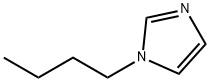
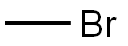
The general procedure for the synthesis of 1-butyl-3-methylimidazole bromide salts from N-butylimidazole and methyl bromide is as follows: all ligands (except 3) were synthesized by improving the method of Starikova et al [20]. The typical and general synthesis procedure is as follows: N-monosubstituted imidazole (0.1 mmol) was placed in a two-necked flask with anhydrous toluene and stirred until a homogeneous solution was formed. Subsequently, alkyl halides (0.3 mmol) were added slowly and dropwise under continuous stirring. After addition of the alkyl halide, the mixture was heated at 40°C for 24 hours with stirring. Upon completion of the reaction, the solvent was removed and the resulting ligand was dried under vacuum.2.2.3 1-Methyl-3-butylimidazolium bromide (4) as a colorless oil in a yield of 1.98 g (91% yield).IR (ATR, cm^-1 ): 3077, 2959, 1626, 1570, 1463, 1166, 1109, 752, 619, 460; ^1H NMR (400 MHz, CDCl3): δ 0.74 (3H, t, J=7.4 Hz, CH3), 1.18 (2H, m, CH2), 1.70 (2H, m, CH2), 3.92 (3H, s, NCH3), 4.14 (2H, t, J=6.7 Hz, NCH2), 7.42 (1H, s, NCH). 7.53 (1H, s, NCH), 10.03 ppm (1H, s, CH); ^13C NMR (100 MHz, CDCl3): δ 13.41 (CH3), 19.37 (CH2), 32.11 (CH2), 36.65 (NCH3), 49.72 (NCH2), 122.29, 123.83, 136.99 ppm; m/z (ESI) 139.4 (M^+ -Br^-); HRMS (ESI) calculated value C8H11BrN2, 139.12352 (M^+ -Br^-); measured value, 139.12327 (M^+ -Br^-).