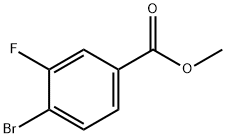
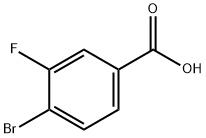
Step 2: Under nitrogen protection, 1-methylpiperazine (980 μL, 8.80 mmol) was dissolved in toluene (15 mL), and tris (dibenzylideneacetone) dipalladium (201 mg, 0.22 mmol), BINAP (550 mg, 0.88 mmol), and cesium carbonate (4.30 g, 13.2 mmol) were added sequentially. The reaction mixture was stirred at room temperature for 30 min before adding methyl 4-bromo-3-fluorobenzoate (2.05 g, 8.80 mmol). Subsequently, the reaction system was heated to 105 °C with continuous stirring for 18 hours. After completion of the reaction, the mixture was cooled to room temperature, filtered through a diatomaceous earth pad and the filter cake was washed with ethyl acetate. The filtrates were combined and concentrated under reduced pressure to give an orange oily crude product. The crude product was purified by silica gel column chromatography using 5% dichloromethane solution of methanol as eluent. The target fraction was collected and concentrated under reduced pressure to afford methyl 3-fluoro-4-(4-methylpiperazin-1-yl)benzoate (1.80 g, 81%) as a colorless oil. The structure of the product was confirmed by 1H NMR (400 MHz, CD3OD) and mass spectrometry (EI): 1H NMR (400 MHz, CD3OD): δ 7.78-7.73 (d, 1H), 7.64-7.59 (d, 1H), 7.09-7.03 (m, 1H), 3.86 (s, 3H), 3.26-3.20 (m, 4H), 2.65-2.59 (m, 4H), 2.35 (s, 3H). MS (EI): m/z 253 (MH+).