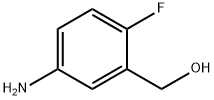
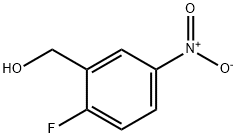
2-Fluoro-5-nitrobenzyl alcohol (2.00 g, 11.9 mmol) was used as starting material and mixed with iron powder (3.72 g, 66.8 mmol) and hydrochloric acid (265.84 mg, 7.28 mmol). The mixture was heated under reflux conditions for 2 hours. After completion of the reaction, it was filtered through diatomaceous earth while hot and cooled to room temperature. Subsequently, the aqueous phase was alkalized with saturated sodium bicarbonate solution and extracted with dichloromethane (CH2Cl2). The organic layer was separated, dried over anhydrous sodium sulfate (Na2SO4), filtered and concentrated by rotary evaporator to afford the brown solid crude product 5-amino-2-fluorobenzyl alcohol (1.51 g, 10.7 mmol, 90% yield). The product was identified by infrared spectroscopy (KBr), which showed that the absorption peaks were located at 3568, 3410, 2930, 1628, 1512, 1439, 1358, 1036, 874, 818, 737 cm-1 ; the 1H-NMR (CDCl3) spectrum showed the chemical shifts δ: 7.26 (broad single peak, 2H), 6.84 (triple peak, J = 9.2 Hz , 1H), 6.75-6.69 (multiple peaks, 1H), 6.61-6.50 (multiple peaks, 1H), 4.67 (single peak, 2H).