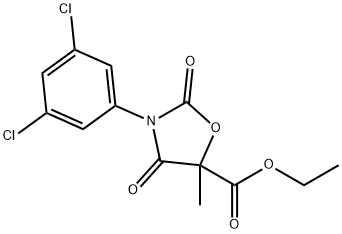
Description
Chlozolinate is an obsolete fungicide. It has a moderate aqueous solubility and is not considered volatile. It is not normally persistent in soil systems and, based on its physico-chemical properties, it is not expected to leach to groundwater. It tends to show a low to moderate toxicity to biodiversity. It has a low mammalian toxicity. No other data is available on its human health effects.
Chemical Properties
Ethylic acid pure product is white odorless solid, melting point 112.6℃. Relative density 1.441(20℃). Vapor pressure 0.013mPa(25℃,saturated vapor method).Kow lgP=3.15(22℃),Henry coefficient 2.29×10⁻³Pa-m3/mol(25℃,calculated value). Solubility in water 2mg/L(25℃), solubility in organic solvents(22℃,g/kg):ethyl acetate, acetone, dichloroethane>250, ethanol 13, n-hexane 2, xylene 60.Stability:Stable under nitrogen protection not higher than 250℃, light stable, hydrolysis environment in aqueous solution pH5~9.
Uses
Chlozolinate controls fruit rot, downy mildew and brown rot in
pome and stone fruits, vines, vegetables, strawberries and ornamentals
caused by Botrytis, Monilia and Sclerotinia, efc.
Uses
Chlozolinate is a dicarboximide fungicide which is used primarily on grapes.
Definition
ChEBI: Ethyl 3-(3,5-dichlorophenyl)-5-methyl-2,4-dioxo-1,3-oxazolidine-5-carboxylate is the ethyl ester of 3-(3,5-dichlorophenyl)-5-methyl-2,4-dioxo-1,3-oxazolidine-5-carboxylic acid. It is a dichlorobenzene, an oxazolidinone, a dicarboximide and an ethyl ester.
Production Methods
The commercial production of chlozolinate typically begins with the synthesis of its key intermediate, ethyl 3-(3,5-dichlorophenyl)-5-methyl-2,4-dioxo-1,3-oxazolidine-5-carboxylate, which involves a multi-step reaction sequence. First, 3,5-dichlorobenzoyl chloride is reacted with a suitable amino alcohol to form the oxazolidine ring structure. This intermediate is then subjected to esterification with ethanol in the presence of a catalyst to yield the ethyl ester form of chlozolinate. The process requires careful control of temperature and pH to ensure high yield and purity. After synthesis, the compound is purified, often via crystallisation or solvent extraction, and formulated.
General Description
Chlozolinate is a systemic fungicide, used for the control of downy mildew, brown rot, and fruit rot in agricultural commodities.
Mechanism of action
Systemic with protective and curative action. Osmotic signal transduction.
Metabolic pathway
The fungicides, chlozolinate, vinclozolin, and
procymidone, are added to wine after fermentation
and the degradation products are isolated and
identified. Chlozolinate undergoes a rapid hydrolytic
loss of the ethoxycarbonyl substituent to give an
oxazolidine that further undergoes hydrolytic cleavage
to give 3' ,5' -dichloro-2-hydroxypropanilide. The
oxazolidine ring of vinclozolin undergoes a similar
hydrolysis reaction to give the corresponding anilide, 3' ,5'-dichloro-2-hydroxy-2-methylbut-3-eneanilide. Both
of these anilides are stable in wine for 150 days. A
different degradation behavior is observed with
procymidone and leads to the formation of 3,5-
dichloroaniline, which, in turn, breaks down in wine.
Degradation
Chlozolinate (1) hydrolysed rapidly at 25 °C in alkaline solution with DTm
values of 6 hours (pH 6.8) and 16 min (pH 8.3). Three hydrolytic degradation
reactions were observed. The first reaction involved the cleavage of
the ethyl ester to yield the corresponding carboxylic acid (2). Compound
2 underwent decarboxylation to yield 3-(3,5-dichlorophenyl)-5-methyloxazolidine-
2,4-dione (3). The third reaction involved the opening of the
oxazolidinedione ring to yield 3',5'-dichloro-2-hydroxypropanilide(4)
(Villedieu et al., 1994,1995).
Chlozolinate degraded rapidly in wine during the vinification process
(DT50 0.35 and 0.14 day at pH 3 and 4, respectively). Decarboxylation
resulted in the formation of compound 3 as the major product (Cabras et
al., 1984; Pirisi et al., 1986; Gennari et al., 1992).